Sunday, August 18, 2013

My Analysis Of The Easy Pace Debate


The appropriate or acceptable pace to run at on easy runs is a topic often debated by distance runners and coaches and usually with a wide variety of opinions.  So I wanted to weigh in on the topic here on my blog. As with most things in running, I try to approached the topic with a logical analysis; breaking things down into its elemental parts, defining what the goal is, and then deciding on how best these parts can be used to accomplish this goal.  What I am presenting here is my interpretation of each of these things (rarely is it 100% black and white).

The Goal

The goal of an easy/recovery run is to recover from a stress workout, while maintaining or advancing our general aerobic fitness and cellular adaptations to running.  Easy/Recovery runs are a key part of the stress and recovery principle, which states that we must stress a body in a certain discipline (running) and then allow the body to recover, and once it has recovered it will be better adapted to the stress than it was before (fitter).  (see illustration above)  I call one complete stress and recover cycle a “base unit” in our training.  The easy run is an integral component of the base unit, as this is where the super compensation occurs. 

Given this goal, the question becomes how much and at what pace should our easy running be in order to recover and gain the super-compensation benefits, while still maintaining or advancing our aerobic fitness and adaptations. 

The answer to that question will depend largely on how hard the stress portion of the base unit was, and how long we have to recover before our next stress workout.  The answer would likely be different if we have 3 days between stress workouts than it would be if we have to have just 1 day between workouts.  But not so much the pace of the easy runs, but rather the duration of them, as I will explain in a minute.

The Elemental Parts

How much work/effort we do in any run is a product of multiple factors including the duration of the run, the pace we run, the course we run on and the weather condition.  In this analysis I hold the other elements constant so I can focus on the duration and speed components of this equation. 

To give us units to work with let’s use minutes of running for the duration, and for the pace let’s use a percentage of lactate threshold pace. (I define lactate threshold pace as roughly the pace we can hold for 60 minutes in an all-out race effort).

Both speed and pace are critical in our analysis.  60 minutes at 75% of lactate threshold (LT) pace is a greater overall effort than 30 minutes at 75% of lactate threshold pace; likewise 60 minutes at 85% of lactate threshold pace would be a greater effort than 60 minutes at 70% of lactate threshold pace. So we must consider both in reaching our goal. 

In the book “Daniels’ Running Formula”, Dr. Jack Daniels develops a chart that assigns a single point value to each run based on the duration of the run and the relative pace of the run.  If we determined that in order to recover from our last stress workout before our next one, that we could only do a run of 20 point in value on Dr. Daniels’ chart, then there would be multiple ways to get those 20 point.  We could run a shorter duration at a faster pace or we could run for longer but at a slower pace.  In theory either way would produce the recovery desired. 

So then one might state, “so it doesn't matter how slow or fast I run then right, as long as I adjust my duration to match”.  My answer to that would be “only within a certain range”.  Here is why:

If we run too fast on the run (faster than a certain point) we begin substantially stressing certain systems of the body that we want to be recovering from the previous stress, not stressing again.  This manifests itself by reduced performance on our stress workout days and a feeling of not being recovered from our last stress workout.

The slower we run, the less muscles fibers that are actively being used and the less bio-mechanically efficient we run.  So if we run too slow on the easy run (slower than a certain point) we may be teaching our body bad bio-mechanical habits, and even worse, doing so for an extended period of time.   We run fast intervals at times on our stress days to teach our body to operate more efficiently/economically, but similarly if we subject our body to prolonged periods at paces that are too slow, we can teach it to be inefficient and bio-mechanically uneconomical.  This manifests itself not on our slow days (which are easy) but through being more injury prone on our stress days and long runs, where our bio-mechanical bad habits become more dangerous.  But because the injury or problem happens in a stress workout rather than easy run day, most runners and coaches fail to make the connection to their easy run paces.

So what we want to do is run our easy runs slow enough to let the necessary systems recover and fast enough not to teach our body bad bio-mechanical habits.   So what is that appropriate easy pace range?  I believe this range to be (and many other elite coaches and researchers seem to generally agree) between 20% and 30% slower than lactate threshold pace or roughly 65% to 75% of maximum heart rate (for those who use a HR monitor). 

So if your lactate threshold pace is 6:00 per mile, than your easy runs would be best done at a pace of between 7:12 (6:00 + (6:00 x .20)) and 7:48 per mile (6:00 + (6:00 x .30)). 

Note: These paces may need to be adjusted for weather and/or course conditions.

With this safe pace range set then, the variable we change is our duration in order to get the proper recovery needed.  Gradually over time, as our fitness and capacity grows, we may be able to increase the duration of these easy runs.  Easy pace can also progress to the extent our lactate threshold improves.

If in our training, we use a 3 day base unit: a stress day followed by 2 easy run days as recovery, at the beginning of the training cycle we may determine that we can run for 50-60 minutes in our easy run pace range (20-30% slower than LT pace) and be properly recovered for the next stress workout.  Gradually during the course of the cycle or over the course of the year, this duration may increase, to say 60-80 minutes, as our work capacity grows. 

Common Mistakes (IMHO)

One mistake (in my opinion) that I often see runners make is they determine the distance they want to do on a recovery day first and then adjust the pace accordingly.  This happens often with marathoners who want to increase mileage too quickly.  This leaves them susceptible to running too slow (teaching the body bad bio-mechanics) if they pick a distance that doesn't allow them to stay in the easy pace range I have outlined.  These runners feel great about getting in the extra distance, but run the increased risk of injuries from running for prolonged periods in an inefficient manner.   

I suggest that instead they should determine the appropriate easy pace  (20-30% slower than LT pace) and then see how much distance/duration they can cover at that pace range and still adequately recover, and start there and try and grow that as their fitness improves.


Another mistake I often see is, runners running outside of their appropriate easy pace range on their easy days, in order to run with runners who are faster than they are.  This often results in the runner not adequately recovering from the last stress workout and thus not getting the full super-compensation (bump in fitness) they should/could be getting from the work they did. 

While I know it’s tempting to run with faster runners on a day when it’s possible to keep up with them, but good and effective training requires adhering to the principles of stress and recovery.  Luckily the easy pace range is larger than most hard training paces, so this does allow for some runners of slightly different fitness levels to run together at a pace within both of their easy pace ranges, but runners should be careful not to stray too far outside their peer group on recovery runs.  

Happy Running!

Coach Mark Hadley

Thursday, August 1, 2013

The 2016 U.S. Olympic Marathon Trials: Qualifying Window Opens!


Any U.S. citizen wishing to compete in the 2016 Olympics in the marathon representing the United States, must first qualify for the trials race, and then finish in the top 3 spots in the trials race, in order to earn themselves an U.S. Olympic team birth.

Qualifying For The Trials Race
In order to qualify for the 2016 U.S. Olympic Marathon Trials, the athletes must meet the following standards (information copied from the USATF website):

                                                         Event                    "A"                         "B" 
                  Men                              Marathon            2:15:00                  2:18:00 
                                                        Half Marathon                                    1:05:00  
                 
                                                          Event                    "A"                         "B" 

                Women                          Marathon            2:37:00                  2:43:00
                                                       Half Marathon                                    1:15:00 

Qualifying window:  August 1, 2013 until 30 days prior to the designated Olympic Trials race.

Qualifying Guidelines
  1. Athletes must meet the "B" standard in order to enter the 2016 U.S. Olympic Team Trials – Marathon event.
  2. The qualifying mark must be made in a race on a certified course Sanctioned by USA Track & Field or a member federation of the International Association of Athletics Federations (IAAF). The course must be USATF/IAAF/AIMS certified with an active course certification and have an elevation loss no greater than 3.25 meters/km. All course configurations will be accepted (no minimum separation). 
  3. The qualifying standards must be met from August 1, 2013 until 30 days prior to the designated Olympic Trials race.
  4.  All qualifying performances are subject to verification.
  5. "Gun" time is the only acceptable method of timing. Chip/net times cannot be used for qualifying. Consideration may be given to "chip/tag" times for competitors with "gun" times extremely close to the above qualifying standards.
  6. Athletes meeting the “A” standard will be provided funding support.
Trials Race Date
The date(s) and location(s) of the trails race have not yet been announced.  During the last 30 years the trials races have been held as early as the November the year prior to the Games and as late as May the year of the Games.  It seems very likely that the trials would again be sometime within the window, making them between November 2015 and May 2016 (although this is not guaranteed).

Qualifying Window: Open
Based the above information, the qualifying window for the trials standards is officially open as of today!   I would suspect that we will see many athletes seeking to secure their trials spot with a performance this fall (2013), or next spring or fall (2014), in order to not have to chase a time in the months leading up to the trials.    

EliteMarathoning.com's 2016 U.S. Marathon Trials Project
A year and half ago I started a website called EliteMarathoning.com as a way to share a very successful training and racing philosophy for the marathon, in order to be a good reference tool for runners and coaches alike.  My goal in starting the site was to help and encourage people to train to run the marathon at the highest levels in the sport.

When the 2016 U.S. Olympic Marathon Trials Standards were announced in December 2012, I decided what better way to encourage and help people to train at a high level in the sport than to help them qualify for and do well in the Marathon Trials.  It is something that gets many people motivated and provides them with a lofty but attainable goal to work towards. 

So through EliteMarathoning.com, I started the 2016 U.S. Marathon Trials Project in which I provide personal coaching and encouragement to help Project members achieve their goals in relation to the U.S. Marathon Trials and the marathon event. 

In the first 6 months the Project has grown to 10 members before the trials qualifying window even opened.  The project members range from those who sole goal is to meet the qualifying standard and compete in the trials, to those who have competed in the trials before and want to go back, to those who goals include making the Olympic Team.   

In the months and years ahead, I hope to add more members to the Project’s ranks, and help all of the Project members earn their qualifying times and meet or exceed their goals at the trials.  And then repeat the process again in subsequent Olympic cycles (2020, 2024, etc)

You can read more of the 2016 U.S. Marathon Trials Project at:  www.elitemarathoning.com/trialsproject.html

If the Project doesn't align with your goals in the sport, but you would like to support our efforts, please consider buying one of EliteMarathoning.com’s t-shirts:


These performance t-shirts can be purchased at:  http://www.mprunning.com/store.html

Happy Running!

Coach Mark Hadley

Wednesday, July 24, 2013

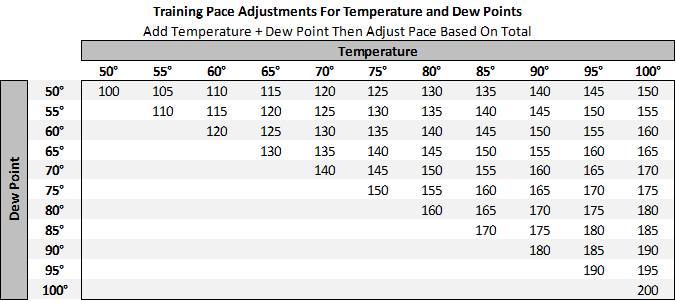
Temperature + Dew Point For Pace Adjustments


Since Dew Point is a more useful measure of the water saturation of the air and thus its effect on our body while we run, I am recommending using it (rather than relative humidity), in conjunction with air temperatures, in determining warm weather pace adjustments to training.

The revised training pace adjustment formula is as follows:

Add together air temperature and dew point and see where the combined number places you on the following adjustment chart:

100 or less:   no pace adjustment
101 to 110:   0% to 0.5% pace adjustment
111 to 120:   0.5% to 1.0% pace adjustment
121 to 130:   1.0% to 2.0% pace adjustment
131 to 140:   2.0% to 3.0% pace adjustment
141 to 150:   3.0% to 4.5% pace adjustment
151 to 160:   4.5% to 6.0% pace adjustment
161 to 170:   6.0% to 8.0% pace adjustment
171 to 180:   8.0% to 10.0% pace adjustment
Above 180:   hard running not recommended

Note:  a range is given as there are numerous individual factors, such as the size, fitness and physical make-up of the runner, and their level of acclimatization to the heat and air saturation levels, that will play into how much of a pace adjustment is needed.   

The above are the pace adjustment percentages to use for continuous runs.  For repeat workouts such as 400’s 800’s, or mile repeats, I recommend using half of the continuous run adjustment as the body has a chance to cool somewhat during the recovery between repeats. 

For those who want help doing the math for these adjustments the following charts calculate the adjusted pace for various paces and % adjustments.


Examples:

At the time of our planned continuous run the air temperature is 74 degrees and dew point if 71 degrees - a typical early morning in summer over much southern United States this summer.  We would add these 2 numbers together to get 145 (74 + 71).

According to our chart, a total of 145 calls for a pace adjustment of 3% to 4.5%.  We had planned to do our run at 7:00 pace under normal conditions, so we adjust the 7:00 pace by 3% to 4.5% and get an adjusted pace range of 7:13 to 7:19 per mile.  

If, under those same weather conditions we had planned to run 8 x half mile repeats at 3:00 per repeat (6:00 per mile pace).  We would cut the 3% to 4.5% pace adjustment in half and use a 1.5% to 2.25% pace adjustment.  A 1.5% to 2.25% on 6:00 pace is a 6:06 to 6:08.  So instead of targeting 3:00 per half mile, we would have an adjusted target of 3:03 to 3:04 per half mile.

Prior Method
Most of the pace adjustments obtained using this method align very closely to what I have shared previously when using relative humidity to adjust air temperature; but I believe the use of both dew point and air temperature to be a more accurate basis for the adjustment calculations, so I am offering this modification.  

Wednesday, July 17, 2013

Sharing My Workout Toolbox

My Metaphorical Workout Toolbox

One of the most valuable items I have as a coach is my workout toolbox.  This is a listing of all the workouts I use as a coach and notes about when, where, why and how to use each to its maximum effectiveness. 

I have a rather large toolbox and am always seeking ways to improve and expand it.  I am constantly reading, thinking, analyzing and talking with other coaches and runners about the various tools used in training.   But I am also picky about what is in my toolbox, so I have some very stringent criteria that must be met before a workout is added.   Before a workout is added to my tool box I must have a thorough understanding of:
  •    The basic physiology of the workout – what systems does it work and how
  •    When to use the workout
  •    How to best execute the workout
  •    Any variations of the workout and how do they differ from each other
  •    How effective is the workout at producing results

The sources for workouts are almost endless.  It is bound only by resources and imagination.  The sources of the workouts currently in my toolbox include:  personal experience as a runner, experiences as a coach, the experiences of friends and colleagues, through reading articles, books and research reports, by talking with other coaches and runners, and hours of research, analyzing and brainstorming.  

I am also not afraid to tweak workouts once they are in the toolbox.  I am always seeking ways to improve them and make them more effective or identifying new variations to be used in certain circumstances.  As new information or research is available, and as experience with each workout grows, I may modify or expand a workout in the toolbox or add a new workout.  I think my toolbox has been through the fire and proven to be extremely effective, but I am never satisfied with that, I want it to be even better and will always work to make improvements to it.  As a coach I want to have the most effective, bad-ass toolbox in the business, so I can be the most effective coach I can possibly be at helping runners reach their goals and maximum potential in the sport.

Organizing the Toolbox
My tool box is organized into 2 tiers.  The first tier is general workout category based on the primary purpose of the workout.
·         Speed
·         Stamina
·         Endurance
·         Recovery

Then under this first tier is a second tier based on the prevalence of the workout in terms of how often and when it can and should be used.  This tier is broken up into:
  •  Staple Workouts
  •  Breakout Workouts
  •  Specialty Workouts


Sharing My Toolbox
On August 1st, I will be launching a new retail page to my coaching services and resource website mprunning.com.  On this page I will be offering to share a substantial piece of my toolbox with you, and in a detailed way beyond what is found on my websites or blog, through a product entitled:   

Coach Hadley’s Workout Toolbox

This offering will include:
  • Detailed notes, instructions and tips on the top 18 workouts in my toolbox. 
  • Training pace charts so that you can easily determine the correct pace ranges to use for each workout based on your (or your athlete’s) current fitness level 
  • All organized on to 8” x 5” note cards, laminated, so they can easily be taken to workout sites to be used and referred to.  


Wednesday, July 3, 2013

The 5th Tenet: Passion!


“A life lived with passion, even if it fails to reach its goals, is far superior to a life lived without passion, even if it is successful”

For the last couple of years you have heard me talk about what I believe to be the 4 tenets of training for distance running in order to achieve your full potential in the sport:  consistency, capacity, frequency and mixture.   Today I want to introduce you to a 5th tenet:  Passion!

Let me explain what I mean by passion in terms of distance running, and how it is a vital component to our success.

Passion:  A deep desire and love of the sport to the point that you decide to do your very best and develop the talent you have for it.  This passion requires that you maintain a positive attitude about training and racing because running is seen as a great gift and as such it is a privilege to do no matter the outcome of the run, workout or race.

This passion, by its very definition, requires us to also approach training in a smart and disciplined manner, as well as an enthusiastic one, because it will take smart training coupled with hard training to reach our full potential.   This means while enthusiastic about workouts and working hard, we must balance that enthusiasm in order to make sure we adhere to the other tenets of training, because ultimately we must have all 5 tenets working together in unison in order to realize its full synergy.  

Thing we need to know about this passion we seek:
  • Passion is part feeling and part conscious decision – we have to want it (the easy part) AND have to make the conscious decision to embrace it and make it happen (the hard part).
  • If it is not fed and safe guarded, passion can be diminished or even extinguished and if not kept in check it can burn too high and burn out.  So the passion we seek avoids the extreme highs and lows and instead steadily and resolutely marches forward towards its goal.
  • The passion we seek is a strong burning but resolute flame, the kind that can weather the storms that will surely come from time to time, the one that will slowly forge our bodies and minds in to rock hard manifestations of distance running prowess over months and years of work.
  • When tough conditions present themselves, such as inhospitable weather or challenging courses, this passion embraces the challenge before it and see it as an opportunity to grow, harden itself and improve.  Its thoughts are never “how do I survive this” but rather “how do I conquer it”. 
  • Passion is an attitude that permeates all aspects of our training on a daily basis, not just when we get ourselves psyched up.  It is positive, it is resolute, and it is unwavering. Ups and downs in training do not affect its strength or mission. 
  • If we train with passion we have no need to brag or be obnoxious on race day to try and psych ourselves up, instead we arrive on the start line with a calm confidence, knowing we are ready for the task at hand.  

When this passion and attitude is coupled with the other 4 tenets, we become a virtually unstoppable distance running machine. The only question is when we will arrive at our goals, not if we will arrive.  That is not to say we won’t have set backs or make mistakes along the way, but when we do we will learn from them and quickly rise again and march forward again towards our goals.  Just like a fully loaded freight train, we will be almost impossible to derail until we reach our goals and beyond.

My 5 tenets to successful distance running training:
  • Consistency
  • Capacity
  • Frequency
  • Mixture
  • Passion


Monday, July 1, 2013

Staple and Breakout Workouts

A Very Motivating Breakout Speed Workout 

Every training program should be comprised of both staple workouts and breakout workouts. 

Staple Workouts:  These are the tried and true workouts that are very effective at working certain targeted systems in a very direct manner.  These workouts include things like VO2 Max repeats, LT tempo runs, and the easy pace long run.  They are simple, straight forward and usually very effective.

Breakout Workouts:  These are the workouts we add into the program in order to spice things up, work systems from a slightly different angle in order to spark new growth in order to keep the fitness progression from stagnating.  These workouts include things like hill repeats, wave tempos and progression runs.

Mixture
Staple workouts will comprise the majority of the workouts we do in training but the exact mixture between staple and breakout workouts will depending on many variables including previous training cycles, number of years of purposeful training, and length of the current training cycle. 

Similarly, what breakout workouts we utilize will depend on variables such as the individual’s strengths and weaknesses, their prior training, and what distance they are training for. 

Good intuition, lots of experience, and a sound understanding of the physiology of all the workouts, are the keys to finding the right mixture between staple and breakout workouts and also finding the right workouts within each to utilize and when. 

Tips
  • Have a couple of different breakout workouts for each workout category – speed, stamina and endurance. 
  • If your fitness progression in a certain category starts to stagnate, add in a breakout workout for that category into your training. 
  • Keep a training log and note the breakout workouts you have used in the past that have been the most effective for you.  


Monday, June 24, 2013

Blood Tests For Runners


As distance runners we are diligent with our training routines and try and make sure we are doing all the little things we need to in order to make sure our body is fit and ready to train and race hard.  But it isn't always as simple as it sounds to make sure that you are adequately or optimally doing everything .  In blocks of hard training the things we need to keep up with and monitor go up, and the things we do in easier training may not be adequate any longer.   

Specifically in this blog I am referring to the level of hydration, electrolytes, vitamins, minerals, enzymes and hormones that our body needs in order to perform at its maximum.    In order to monitor and ensure these areas are at optimal (or at least sufficient) levels I am recommending that competitive runners, especially those running higher mileage levels, have some simple and relatively inexpensive blood tests performed on a periodic basis.   The benefits of doing so is 2 fold – first it helps us determine if there is any area of immediate concern that may be derailing or jeopardizing our current ability train and race optimally; and secondly by tracking our test results over time, we can see pick out any potential troubling trends and better learn our body and at what score in various areas do we usually perform our best.  These periodic tests can help us fine tune our ancillary (non-running) routines in order to help us perform at our best. 

OK so how often and what should I test?  Good questions and like most things on our sport the answer is “it depends”.   But I do have some basic recommendations that are a good start and something I think will be sufficient for the vast majority of serious runners.  Then as we follow these recommendations we can tweak what do to optimize it for our specific situation. 

What Tests To Have
Here is what I recommend that you get tested as part of your periodic testing program:

CBC – Complete Blood Count:  this will give you the white blood cell count, red blood cell count, hemoglobin levels, hematocrit levels, white blood cell types, red blood cell density and blood platelet counts.   Several important things in here to track and some that provide indications of infections, and other problems.

TSH Levels – This gives you a basic indication if your thyroid gland is working appropriately or at least indicate if a more thorough tests should be done in this area. Some runners have problems in this area.

Ferritin Levels – this is a good indicator of the iron stores available in your bone marrow to make new red blood cells.  Many runners, especially higher mileage runners, tend to be too low in this area if they don’t supplement iron intake.   Olympic Marathon Champ Joan Benoit Samuelson, a notoriously good eater, says that iron was the only thing she had to regularly supplement. 

Chemistry Panel – this is a test for many mineral levels in your blood, including key electrolytes such as sodium and potassium.  Also can give you a good indication if you are dehydrated and if you are high or low in any of these key minerals.   

Additional tests can be included such as glucose levels, iron and vitamin D, or others if desired or if you have reason to suspect something may be up or need to be tracked based on personal or family history. 

You can request these tests from your primary care physician or go to an independent lab testing facility, such as “Any Lab Test Now”, and have these tests run.   It is simple and the results are usually back within 48 hrs.   The cost will vary based on if you go through your doctor, what your insurance is,  or if you use an independent facility.  I know that I can get all of the above tests done through “Any Lab Test Now” for a total of $129 (their “Basic Check-up Panel” with Ferritin substituted in place of the Lipids test).

Reading The Test Results
All of these test results will come with a list of what is considered the “normal range” and what your score is.  But keep in mind that what is optimal for an athlete in serious training and what is “normal” may not coincide perfectly.  I recommend that you either find a reputable person in sports medicine who is use to working with athletes and reading blood tests results, to go over your results with you; or you take some time to do some research and reading and educate yourself on how to interpret the results yourself. 

Once you get your results start a spreadsheet and enter your results for each test and the date of the test.  Then when you get the test done again, note your new levels on the next column/row.  This way you will have an easy place to see any trends and possibly catch some potential problems before they fully manifest themselves.   In certain tests you will notice certain levels at which you feel best and what you need to do to get there (such as ferritin and what level of iron supplementation you need to achieve that ferritin level). 

How Often To Test
I recommend having the complete battery of tests done 2 to 3 times per year, with a follow-up test in-between on any area that is outside of the desired range.  For example, if I get the full run of tests done in January and everything looks good except for my ferritin levels, I may make some changes to my iron supplementation routine and then just have just my ferritin levels tested again in March to make sure my changes are working.  Then have the whole battery of tests done again in May or June.   Additionally if you run into a period of a few weeks in which we aren't feeling well and something seems off, by getting the full battery of tests it may help you isolate the problem. 

As serious runners, we want to leave no stone un-turned as we seek to achieve our goals, and these test can help us make sure we are doing what we need in terms of hydration, nutrition, vitamins and minerals, as well as point out any issues that may be lurking. 

Return on Investment
While following this recommendation can costs a few hundred dollars per year, it can also help make sure that you are getting the most out of the hundreds of hours you are putting into training and often the thousands of dollars you are investing in race entries and travel to races.  In all a very good return on your money in addition to the invaluable peace of mind it can bring.

Happy Running,


Coach Mark Hadley