Tuesday, October 4, 2016

Chapter 2 - Stress & Recover

Note: To me coaching is all about stewardship, using the knowledge and experience I have gained over 40 years as a runner, and 10 years as a coach, to help others pursue their running goals.  So rather than publishing a book you have to pay for, I am publishing it here on my blog, free for all (runners and coaches alike) to read and enjoy, maybe learn something from it, or potentially have it prompt you to look at something from a slightly different viewpoint.  If any of those happen, mission accomplished.   


The base principle that governs all physical training is the principle of stress and recover.  This principle simply states that if we physically stress the body in a certain way and then allow it to recover, it will bounce back better adapted to that stress than it was before.  

In running we stress the body by running either far or fast (or both) and then let the body recover by running short and easy or by resting, and once the body has recovered from that initial stress it becomes stronger and better adapted to that stress, and as such we become fitter runners. This is the essence behind what we are doing in training.  Stressing then recovering to move our fitness forward in some specific areas such as speed, stamina and/or endurance.

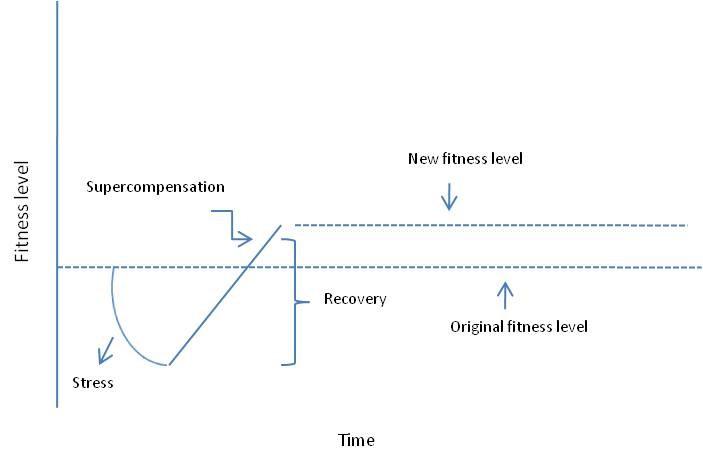
Figure 2-1
It is important to note that this principle has 2 important steps: 1) stress and 2) recover, and that one without the other does not accomplish the adaptation (increase in fitness) we are seeking.   

In the Figure 2-1, we start the base unit at our “orginal fitness level” and then we perform a “stress” workout.  This stress workout breaks down the body and our ending fitness level is lower than where it started.  It is easiest to see this through an example.  If our stress workout is a 5k race, then at the end of the 5k we cannot then go out and run another 5k as fast as we just did, because our effort in the 5k significantly stressed the body so it is not as strong as when you started.  But then we allow the body time to recover, and when as it does the body heals itself and adapts to the stress (in this case the 5k race).  This adaptation and advancement in fitness is called the super-compensation.  Through this super-compensation our body comes back after the recovery fitter than it was before in terms of the systems that the workout stressed.  

If you do not allow enough recovery between stress workouts you will not get the full super-compensation you are seeking. So to get the most from a stress and recover cycle, you must do the proper stress workout to work the fitness area you are seeking to improve, and then allow sufficient recovery afterwards so that the body can get the full fitness gain that the stress workout earned you. A very simple concept but one that many runners, from beginners to elites, struggle with consistently executing to its fullest. This base unit (1 stress and recovery cycle) must be mastered in order for training to be as effective as it can be.

I refer to 1 stress and recover cycle as a “base unit” because it is the basic unit upon which all our training is built.  In order for a runner to be as successful as possible it is imperative that they understand and master this base unit.  So with that in mind, let's clearly define each aspect of it.

Stress
Stress workouts are running workouts in which we significantly stress a system or systems of the body in order to produce a targeted adaptation so as to improve certain aspects of our running fitness.  Our goal is to do sufficient and specific enough work in order to elicit the adaptation we are seeking, while still be able to recover from that work relatively quickly so that we can soon after target another adaptation.  In order to keep the training process moving forward and to be able to target all necessary systems with adaptations on a regular basis, a stress workout should usually be able to be recovered from with 1-3 easy/recovery days.  In Chapter 3 we will explore the types of stress workouts I recommend for distance runners in more detail.  

Recover
Recovery in running takes the form of recovery periods of time between runs and the easy runs we do between stress workouts in order to promote recovery, and to maintain or advance the body’s adaptations to running while we recover.  These runs should be kept short and slow enough that they do not significantly stress the body, but with enough pace to them to maintain bio-mechanical efficiency.  In Chapter 4 we will explore recovery and easy runs in detail.  


This chapter and the basic concept of stress and recover is something we need to keep in mind as you go through the other chapters in this book.  In order to get the most from all the stress workouts and training phases and training cycles we will discuss, it must be done through the successful use of the stress and recover principle.  Master this base unit first and foremost in your training, and you will get the most from everything you do.

Tuesday, September 27, 2016

Chapter 1: The 5 Tenets of Training

Note: To me coaching is all about stewardship, using the knowledge and experience I have gained over 40 years as a runner, and 10 years as a coach, to help others pursue their running goals.  So rather than publishing a book you have to pay for, I am publishing it here on my blog, free for all (runners and coaches alike) to read and enjoy, maybe learn something from it, or potentially have it prompt you to look at something from a slightly different viewpoint.  If any of those happen, mission accomplished.   


Chapter 1:  The 5 Tenets of Training
  
When it comes to studying any topic, I have found it is very helpful to break it down into its elemental parts and understand how they fit together in order to make up the whole.  When you do this it helps you understand what the key drivers are, the things that make other things happen and determine the outcome.  When I first got into coaching this was one of the first things I did.

I have a long background in the sport of distance running, having started running road races and track meets as a grade school kid back in western North Carolina, and became obsessed with the sport at an early age.  I checked out and read and re-read almost every book on the sport that was available at the Henderson County Public Library as a kid. From Lydiard, to Fixx, to Henderson, to Moore, if you had written about running back in those days I probably have read and re-read your stuff.  This obsession continued on through high school and then into college where I ran track and cross country for the University of Mississippi.  I would spend hours sitting around talking running and training with friends and teammates who were almost as obsessed with the sport as I was.  Post collegiately I continued to run in road races and with the advent of the internet age more and more information became available, which I eagerly devoured.  So when, in my 30’s, I started getting into the coaching side of the sport I had almost 3 decades of experience, reading and studying to draw from.  

I added to this background in running, the training I gained in analysis during my work as a business and financial analyst in the corporate world over my first 15 years post college.  I was trained and became experienced in the art of tearing down a business into its elemental parts so that I could understand how it works, what the key drivers were, and then build up a model of that company so that management could forecast results and run “what if” scenarios through it to see how various factors would affect outcomes.  

So as I went into coaching, I combined my experience and knowledge in the sport with the analytical skills I had learned in the corporate world.  One of the first things I did was sit down and determine what were the key drivers of training for distance running.  What were the things that we could control that would ultimately determined how successful we were in our training.  This first chapter is about what I found, what I believe to be the “5 Tenets of Training” for distance running, as it has shaped how I approach training runners for the sport.

My 5 tenets of training for distance running are:
  • Consistency
  • Capacity
  • Frequency
  • Mixture
  • Passion
Each of these 5 tenets are critical in our training and development as distance runners, but they are all interconnected.  So our degree of success will lay not just in how well we develop any one tenet, but how well we balance and raise our game in all 5 tenets together.

Let's take a look at each tenet in a little more depth:

Consistency

Distance running is a fitness sport in which we have to slowly and methodically build up our fitness and adaptations to the sport over time.  Consistency then is a tenet in our training because the more consistent we can be in your training, the higher we can raise our fitness level.  In Chapter 2 we will discuss the Principle of Stress and Recover which will underscore in more detail the importance of consistency in building fitness.  

Interruptions in our training, even minor ones, at a minimum delay our fitness build-up, and when long enough or frequent enough, lead to a backslide in fitness and physical adaptations.  When we experience an interruption in training, not only do we lose that time associated with the interruptions, we also lose the time associated to build back the fitness and adaptations we lost during the interruption.   So if we lose 2 weeks of training due to an unexpected trip, our cost is not just those 2 weeks but those 2 weeks plus whatever time it will take to build back up the fitness or adaptations we lost during those 2 weeks.  Often interruptions can cause a loss of twice as much time as the actual interruption lasts.

So a major focus in our training needs to be on consistency so that our fitness has a chance to build and progress as much as possible during our training cycle.

Capacity

Capacity refers to the work capacity we build up in training.  It is the amount of work we can do consistently in training and is made up of both a quality and quantity component.  The numbers of miles we cover in a normal training week can be a good gauge as to the quantity aspects of work capacity and the number of stress (“hard”) workouts we can do per week can be a good judge of our quality density component of our work capacity.

Simply put, our work capacity is a major tenet of our training because the more work we can handle on a consistent basis, the more we can accomplish; the more fitness we can build and the greater the adaptations we can elicit from our training.  

A major focus on our training then will be on building up or maintaining our work capacity so that we get the most fitness gains possible in our training cycle.
  
Frequency

Frequency refers to the number of times that we run during a given period of time.  Every time we go for a run of 20 minutes or more our body responds by releasing certain enzymes and hormones that help the body adapt to running and improve our cardiovascular fitness. To a certain extent the more often we run the better adapted to running our bodies become. This tenet has to be balanced with the need for runs lasting for longer durations in order to build endurance, and stamina and other specific fitness points, but to a certain point the more we can increase the frequency of our runs within our training mix, the better adapted to running and fitter we can become. I have established some basic rules for when and how to add additional runs into your regular training schedule and will go over those in Chapter 4.

Mixture

Mixture refers to the stress (“hard”) workouts we do in our training, when do we do them, and how do we structure and sequence those workouts to build our fitness best.  This is the “sexy” part of training that most books and article get written about and will be discussed at length in later chapters in this book.  

The major focus of Mixture is determining what do we need to do to get the most out of our training (i.e what are the demands of our goal race) and how best to structure our workouts and training to accomplish that.  

Mixture is a major tenet in our training because it determines, to a large extent, how well we use the other tenets to build up our fitness.  

Passion

Passion is our continued desire to train and chase our goals.  Passion is a major tenet in our training because it provides us with the motivation and fire to undertake all of the physical and mental components of training.

We cannot undertake training beyond what our passion will allow us to do or it will not last, so our passion needs to be monitored, nurtured and safeguarded as we train.

Synergy Of the 5 Tenets
How successful our training is will depend in large part on how well we balance all 5 Tenets of Training together.  We should never focus solely or heavily of one tenet at the expense of the other tenets, but rather seek to balance and build up all aspects together.  There is a very real synergy that comes from balancing all 5 tenets together in your training.

All of the tenets are interconnected and so when balanced together they help raise each other up and provide more from training.  Being consistent in training makes it easier to build up our capacity and frequency and get the most out of our workout mixture.  Building our work capacity gives us more to work with and helps us get more out of our workout mixture and provides more room for increased frequency.  An increase in frequency allows us to build more capacity and gives us more opportunities to enact our desired workout mixture.  Passion provides the motivation and fire to run consistently, and build our capacity and to run frequently and do all of the needed mixtures of workout to accomplish our goals.  

If we let a focus on one component get out of alignment with the others it can jeopardize the synergy and cause the whole thing to come grinding to a halt.  For example, if we try and increase capacity or frequency too quickly and breakdown we jeopardize our consistency.  Or by focusing too much on building the quantity component of our work capacity we might jeopardize the right mixture we need to continue to improve.  Or if we push forward too far in capacity and frequency, we may extend ourselves too far and jeopardize our passion to want to train.  

Only the careful balance of these 5 tenets will produce the optimal results we are seeking, where we get the most out of the time and energy we have to put into our training.  And ultimately this is what this book is about, how to find and utilize that optimal balance for each of us.  

Scorecard

In the corporate world I worked regularly with a concept called the “scorecard” in which we would look at all the major drivers of our business and we would compare our practices and procedures in that area to the best practices and procedures of all best businesses in our industry.  This helped us determine areas for improvement and growth, and where we could go first for the most immediate improvements.  

So when I entered the world of coaching and had established the 5 Tenets of Training, I brought this “scorecard” concept with me and started to use it determine what components of the runner’s training where in most need to improvement.

For the first 4 tenets; consistency, capacity, frequency and mixture, I was able to develop a scorecard that graded their training on a scale of between 1 and 10 for each tenet, with 1 being what a brand new runner might be doing and with 10 being the best practices of the top runners in the world.  This would allow me to give a score to each runner I worked with in each of these 4 tenets to see where their weaknesses may be and to help plan on how or if to boost each area during their training.  

The fifth tenet, passion, is a little more subjective so hard to put a hard number on.  So in regards to this tenet it is important to understand where running and running goals fits in that person’s life and how important and motivated they are to reach those goals.  Then this would be taken into consideration in designing their training, being careful not to build training past what they might have a passion to maintain.  

Useful Maximums

As you go through the process of looking at yourself, or a runner you coach, in terms of these 5 tenets and where they stand on each, it is important to remember that each runner will have certain useful maximums in each tenet.  A useful maximum is simply the most a runner can realistically do in that tenets because of personal, life or other imposed ceilings. These useful maximums can and often do change over time.  These maximums are not good or bad, they just are, and it is important to understand them as you design training programs.  If a runner only has the time in their work/life schedule to run 5 times per week, it does no good to try and schedule 7 runs.  If they only have the energy to run 50 miles a week, it is counter-productive to try and push them to run 70 miles a week.  

One of the first steps I take with a runner I start to work with is having them fill out a questionnaire and then have a phone call with them so that I can better understand not only where they are in each tenet of training but where does running and their goals fit into their life, and what useful maximums may exist.  This is important to flesh out and consider these before you can design the best program for them.   It also fosters the conversation on those limitations and how or if they will impact the runner’s ability to reach their goals in the sport.   


Wednesday, August 31, 2016

Your Running Is Yours


There are any number of reasons to run and running can mean so many different things to different people. Some people run to set personal best times; some run for competition, to challenge themselves against others; some run for health or to lose weight; some run as a personal challenge to see how fit then can get; some run for peace of mind or as a therapy to deal with stress or hyperactivity; some run for quiet time to pray or think; some run to explore or enjoy nature; some run for the social and community aspects of the sport; some prefer to pursue long distance such as marathons or ultras and some prefer shorter distances like mile, 5k or 10k.  There are almost an infinite number of possibilities on how someone might choose to partake in running. But none of these reason is right for, or motivates everyone. We are each on our own journey in running and must decide how it fits into our life.

Unfortunately one problem I regularly see as a running coach is runners letting others' expectation dictate how they choose to pursue the sport.  Some people run marathons because they think they are suppose to or because others expect them to, but they really would rather focus on 5k's.  Some run races even though they really have no interest in them simply because it is expected of them by others.  Some are peer pressured into group runs when they really prefer the solitude of solo runs.  None of this happens maliciously, it is just that many people assume others have the same motivations or interest as they do, when often it is not the case.  When you stop pursuing running in the way that is most important to you, and instead follow the path of others' expectations, you will often run into burn-out and disinterest and soon lose your motivation to get out there.

The purpose of this blog then is to point this out.  That running doesn't mean the same thing to everyone and that is OK. In fact that is a beauty of the sport, that it can mean so many different things to different people.  It is fine to take your own path in the sport as long as it is what you want and is true to your interests and passions.  So stand up for yourself, be honest with yourself, and choose to pursue running how it will mean the most to, and be the best for you.  Afterall that is why you started it in the first place. 

And be conscious of the fact that others may have different motivations and goals or uses for the sport than you do.  Be courteous and encouraging to them rather than trying to convert them to your motivations or uses.  There is room in this great sport for everyone, enjoy, embrace and marvel at our diversity.

Happy Running,

Coach Mark Hadley

Monday, August 22, 2016

Sacrifices or Choices

"One of the biggest determining factor in how our training goes, is the attitude we bring to it."

How we frame situations in our own mind plays a big role in the attitude we bring to them.  If we want to be a positive person then we need to frame things in a positive way.  

A great example of this is when people talk about all the sacrifices they make for their running: "I give up sleep, I give up family time, I give up sweets".   This can be a negative way to approach training and leave one feeling bitter, burned out, or even resent it, especially if things do not go well in a particular race or training cycle.  Instead I suggest we would be much better off by viewing it (framing it in our mind) as making a choice.  We choose to go for our runs because the sense of accomplishment (or whatever it means to you) is more important to us than whatever we give up (such as an extra 30 minutes of TV).  We are simply choosing to value our running goal more than some other uses of our time.  Those other uses may be great and valuable, but whatever running goal we have is more important to us. 

This is a decision to focus on the positive, to focus on the positive things we are choosing rather than the negative of what we are giving up.  The end result is a greater feeling of empowerment and control and affirmation that we are taking positive steps towards our goals, which leads to a positive attitude.  But if we dwell on sacrifices, we are focusing on the negative and what we are giving up, which leads to a more negative frame of mind.  

As you go about your day and your training, focus on your choices rather than your sacrifices, and you'll stay happier, more positive and be more effective.  

Monday, August 8, 2016

Summer Training

Summer training, in the higher temperatures and humidity, can provide some great opportunities to receive big fitness gains. The tough weather conditions have been shown to have similar physical benefits to training at altitude and the mental challenge of it can make us stronger runners. But like training at altitude there also comes with the opportunity a risk of over doing it and pushing too hard. To get the maximum benefits from your summer training focus on 4 areas:
- Adjust your training paces. Just like when training at altitude you have to adjust your training paces because your body has to work harder than at cooler temperatures. Adjust more at first and less as your body becomes acclimatized to the conditions. Insisting on trying to run the same paces as you can in cooler weather will just cause you to work too hard and over-train.
- Focus on good hydration. While important all year long, the risk of dehydration or sub-optimal hydration is greatest in the summer weather. Be sure to adopt good hydration practices (100+ oz per day and drinking spread-out through-out the day) and stay diligent to them every day.
- Recovery, recovery, recovery. The summer conditions are extra hard on us mentally and physically, so we must be sure we recover adequately from our stress workouts. Be diligent on all your recovery protocols, keeping easy runs slow, stretching, rolling & massage, ice baths, and sleep. The harder you train, the better you must recover.
- Keep a positive attitude. It is easy to get frustrated and start complaining about high summer temperatures and humidity levels. But keeping a positive attitude is key to making training sustainable. Adjust training paces accordingly for the conditions but don't dwell on weather, instead stay positive and focus on the purpose and benefits of the training. The body tends to follow the mind so staying positive will help you feel better and get the most from training.
Happy Running,
Coach Mark Hadley

Friday, July 29, 2016

Training Is A Collective Not A Singularity


Training for running is a collective, not a singularity.  No one workout is overly important but each has their own place.

FootLocker South Region 2011

It is important to remember in training that no one workout is paramount, but rather it is the collective of all the workouts in the cycle that comes together to improve fitness and produce results. 

In each of our stress workouts we do we are targeting 1 or more physiological systems for adaptations to increase different aspects of your fitness. These adaptations do not come in big chunks but rather gradually and over time.  So a BIG key in training is consistency (one of my 5 tenets of training) because it is not so much 1 workout but stringing together whole series of workouts over weeks and months that produce the adaptations we are seeking.  So if we do a good tempo workout this week, and then another solid one next week ,and another solid one the week after, then we'll start seeing some adaptations taking place and improvements in our stamina.  But if that cycle is interrupted then what you get is a stagnation in adaptations at best, or at worst a regression (loss of adaptation) if the interruption is too long or repeated frequently enough.  This is the sinister physical side of a missed workout or workouts you give up on.  You are interrupting the adaptation process and if you don't end up getting in enough work, you'll experience stagnation or regression in fitness.  

One example where this is easiest to see is long runs.  Most of us know from experience that if we haven't done a long run in a few weeks our first one back is harder than it was previously as our endurance has regressed.  But if we are consistent for a while and string some together on consecutive weekends then they become easier and we can handle doing more or faster on them (adaptations having taken place).

So yes, each time we do a stress workout we want to have a great workout, but we need to make sure that at the very least we get in some good solid work, so we can keep the consistency alive and the progressions coming.  Because how we continue to get fitter is by being consistent and letting these adaptations happen and pile up over time.   We are much better off with a string of solid but unspectacular workouts, than we are a few home runs each followed by a series of workout DNF's. 

Judging Workouts
With this in mind (string together workouts), it is a good remember that the time on the watch does not determine if a workout is a success or failure. If you give the effort and execute the purpose of the workout fairly well, you will get the benefits of it regardless of what the watch might say. Your body doesn't know what the clock says, it only knows how hard you work and what systems you stressed with that effort and that is what brings the benefits. So remember to use your watch as a tool and not as the judge or mental task master, focus instead on proper effort and execution and string together training over the course of a cycle and you'll get the most from your training.

Happy Running

Coach Mark Hadley


Tuesday, June 7, 2016

Race Strategy Guide

Great race execution has its rewards

Overview
When determining the best race strategy to advise distance runners to utilize, I came up with the following criteria to help guide me, I wanted a strategy that:
-        Offered the highest probability of producing the best performance
-        Was physiologically sound
-        Was psychology sound
-        Could be practiced in training to help the runner master it

After studying all the different components involved, and looking at the best results from runners of all ages and ability levels over multiple decades, I have the come up with what I feel is the best race strategy and use and one that meet all of the criteria listed.

Interestingly enough, this general strategy (slight negative split) has been what has been used in the vast majority of world records in distance races over the last 50 years, giving me good confidence in its soundness.

I am also defining the race strategy I recommend in such a way that it can be utilized by runners regardless of how they prefer to monitor their races, whether by pace, effort, or heart rate, so that it may be used by all runners.  

Race Strategy
The race is broken up into 3 segments as follows:

Segment #1:  First 10% of the race - easing into it
In the first segment of the race the runner eases into their goal pace/effort/heart rate. The runner does this by starting conservatively, just slightly slower than goal pace/effort/heart rate and gradually ramping up into the goal ranges by 5-10% into the race.

Physiologically this allows the body to ramp into goal range more efficiently and with a lower energy burn rate and blood lactate level than a more abrupt start allows.  

Psychologically this takes some pressure and stress off on the starting line and in early part of the race, as the runner knows they have time to ramp into their performance.  

Segment #2:  10% to 80% of race distance - strong, smooth and steady
The second segment of the race is by far the longest and encompasses the majority of the race.  It lasts from the 10% mark of the race to the 80% mark of the race or 70% of the total race distance.  Our strategy in this second segment is to run as smooth and even as possible in our goal range (either pace, heart rate or effort).  We want to focus on a good strong sustainable rhythm and staying as relaxed as possible while running in our goal range. 

Physiologically this allows the body to run as expend as little energy as possible while at goal pace range or to run as fast as possible at goal heart rate or effort range. 

Psychologically it allows us to go on auto-pilot and just execute what we have trained to do without over thinking things or getting too caught up in racing.

Segment #3:  Last 20% of race distance - racing home
At the 80% point in the race we do a quick assessment on how much gas we have left in the tank, and then race home the best we can based on that.  At best we may be able to pick-up the pace some in this final segment as we race home, and at worst we should be able to maintain our goal pace if we have executed our first 80% as planned.  Any up-side on our goal comes in this last 20% of the race.  We have raced the first 80% of the race with our heads, following a strategy we should be able to maintain the whole way, and now we race the last 20% of the race with our hearts to finish off the performance and maybe realize some upside.  We use competition to help motivate us and embrace the challenge of pushing and expanding our limits. This last 20% is a huge investment both physically and mentally as we are pushing our limits and dealing with steadily growing fatigue, but that is why we executed the first 80% as we did, to conserve as much physical and mental energy as we could for this last segment.

Physiologically we have set ourselves up well, we have covered the first 80% at a manageable level so now we are free to race home and use up what energies we have left knowing we are close to home and most of the way to great performance

Psychologically we conserved our mental energies the first 80%, not worrying about competition, just executing a solid plan and staying smooth and relaxed and not over thinking.  Now as we hit the final 20% we start pulling out the mental tricks and triggers to help us combat the fatigue.  We let our competition motivate us, we try and catch or pass people (most people positive split races so by executing a slight negative split, we will be passing many more people in this segment than we get passed by), we think of how close we are to a completing a great performance and use it to excite and motivate us.  We break the final miles of the race up in smaller segments and stay in the moment, executing 1 segment at a time.

This Race Strategy:
- helps us run relaxed and efficient and feel good for as much of the race as possible while still maximizing our performance
- helps us stay positive late in the race by structuring it so that we are passing people instead of getting passed late in the race, we race the second half of the race as the hunters not the hunted.
- conserves our mental and physical energies for when we will need it most - the end of the race
- is practicable in most of our training

Establishing Our Goal Ranges
An important part of this race strategy is having a good handle on what your reasonable goal range(s) should be, as we will use it as the basis for the first 80% of the race.  This goal range can be a certain pace per mile or kilometer, or it can be a target heart rate range, or a certain feel/effort we want to give.

Many people find they are most comfortable with using one of these methods as their primary gauge with maybe another one (or two) as a secondary gauge.  For example, you may decide to run based on feel with pace as a back-up guide that is a little more concrete.

You have 2 big tools to use in deciding our goal range.  The results of your training leading up to the race and past experience in races.  The more you have trained and raced the easier this becomes to figure out.  You will have experienced workouts and races and have a good idea what that means for you in this race.  A coach can be a HUGE help on this front, as not only do they know your training and racing background very well, but they have examples and knowledge of dozens (and even hundreds) other runners having done similar workouts and races.

A big key here is to not overextend your goal ranges.  Stick with what is reasonable and that you have a very high likelihood of being able to sustain.  Leave stretch goals and up-side potential to that last 20% of the race and pace the first 80% of the race with solid, realistic expectation.  A great way to do this by using a simulation run or race in your training to practice the pacing you plan to use the first 80% of the race.  As a key stress workout in your cycle, simply run 50-60% of the goal race distance exactly as you plan to run the first 80% of the race.  It can give you good feedback, help your tweak your plan, and boost your confidence on race day.

Goal Range Adjustments
Make sure that after establishing your goals ranges you note any adjustments that need to be made due to course or weather conditions.  This includes things like any big hills on the course or warmer or colder weather conditions than you are use to in your training.  Again data from your training and past races and your coach can help you hone these adjustments.

Example Strategy
Sub 3 Hour Marathon (goal range by pace)
Segment 1:  ease into the race the first 2 miles: 7:00-7:10 for first mile and 6:50-7:00 for second mile
Segment 2:  smooth and steady 6:45-6:50 per mile from 2 to 21 miles, except 6:55-7:00 pace on the hilly section from 10-13 miles
Segment 3:  race it home last 5.2 miles at 6:50 or better pace
Result:  2:59 or better

Approx Race Breakout By Segment
Race DistanceSegment 1Segment 2Segment 3
5kfirst quarter mile.25 to 2.5 mileslast .6 miles
8kfirst half mile.5 to 4 mileslast mile
10kfirst half mile.5 to 5 mileslast 1.2 miles
15kfirst mile1 to 7.5 mileslast 1.8 miles
10 milefirst mile1 to 8 mileslast 2 miles
20kfirst mile1 to 10 mileslast 2.4 miles
Half Marathonfirst mile1 to 10 mileslast 3.1 miles
25kfirst 1.5 miles1.5 to 12.5 mileslast 3 miles
30kfirst 1.5 miles2 to 15 mileslast 3.6 miles
Marathonfirst 2 miles2 to 21 mileslast 5.2 miles

Practice In Training
During your stress workouts in training, practice the general outline we plan to use in racing.  That is: start a bit conservative and ease into it; run strong, smooth and steady during the majority of the workout and then finish a touch faster in the final section (i.e. slight negative split).  In particular practice this approach in your tempo runs and long runs as these are continuous runs most similar to our races.  After awhile of doing this, it will become ingrained and just part of how you normally run, making it second nature to you on race day.

Fueling
The is is an area of race strategy that has gotten a lot more complicated for runners in recent years as there is more options now than ever before.  There are tons of waters, sports drink, electrolyte drinks, energy replacement drinks, gels, gu's, sports beans, chews and lots of "normal" foods available to runners in training and races and all sorts of methods of carrying them with you if desired.  So lets first cut through some of the haze and confusion and establish a base strategy.

Lets start by breaking this up into race durations:
1) races under 1 hour
2) races between 1 and 2 hours
3) races over 2 hours

Next lets break-up the fueling needs into 2 categories
1) fluids/electrolytes
2) energy/calories

Fluids/Electrolytes 
Per serving:  3-6 oz (2-3 good swallows) of water or drink with electrolytes
Races under 1 hour:   1 serving every 20-30 minutes (optional)
Races between 1 - 2 hours:  1 serving every 20-30 minutes  (15-20 minutes in warm weather)
Races over 2 hours:  1 serving every 15-20 minutes
Recommendation: start by alternating servings between waters and electrolyte drink the first half of race then adjust second half by craving.

Energy/Calories
Per serving:  75-100 calories (easy to digest)
Races under 1 hour:  not recommended
Races between 1 - 2 hours:  1 serving every 40-60 minutes
Races over 2 hours:  1 serving every 30-45 minutes
Options: sports/energy drinks, gels, GU's, sports beans, chews, real food (fruit, cookie, etc.)

Experiment In Training
Play with the options listed above in training to figure out what mix and combination works best for you. Do you prefer to get your calories from drinks or gels, or chews.  Does your stomach handle sports drinks OK, and if not which ones does it like or not like.  Your training runs, especially long runs are you chance to figure this out and train your stomach for race day.

Example
Common Marathon Strategy:  alternating between a servings of water and sports drink once every 15-20 minutes plus 1 gel per hour.

Happy Racing,

Coach Mark Hadley