Tuesday, November 15, 2016

Chapter 9: The Fundamental Phase

Note: To me coaching is all about stewardship, using the knowledge and experience I have gained over 40 years as a runner, and 10 years as a coach, to help others pursue their running goals.  So rather than publishing a book you have to pay for, I am publishing it here on my blog, free for all (runners and coaches alike) to read and enjoy, maybe learn something from it, or potentially have it prompt you to look at something from a slightly different viewpoint.  If any of those happen, mission accomplished. 


The third and longest phase of the Hadley Liberty Training Cycle is the Fundamental Phase.  In the Fundamental Phase, the runner is in full training mode, working each facet of fitness to become a fitter runner.  

The Fundamental Phase lays a base foundation of running fitness from which to build to a peak for a certain race distance in the Specific Phase.  So the better we lay this base of fitness, the better position we are in for establishing our peak.  The higher we can raise our base fitness in the Fundamental Phase, the higher our potential peak will be.


With the phase goal established, improving base fitness, how we go about this will depend on what our goal is for the training cycle as a whole. A Fundamental Phase for a 3k goal race will look a little different from Fundamental Phase for a 50k goal race. But lets focus first on the similarities, and there are many, before discussing the differences.

In all Fundamental Phases we will work regularly on all 3 facets of our running fitness: speed, stamina and endurance. Each will come up in our workout rotation on a regular basis and we will seek to build up all 3 over the course of this training phase. At the end of the Fundamental Phase we want our speed, stamina and endurance to all be at significantly higher levels then when we left the Base Phase.

During a Fundamental Phase we are operating in our optimal micro-cycle design (7, 9, 10 or 14 days) as discussed in Chapter 5.  Our stress workouts in these micro-cycles are fairly evenly divided between each of the 3 categories of stress workouts: speed, stamina and endurance.  For example, if we are operating in a micro-cycle where we have 3 stress workouts per micro-cycle then one would be a speed workout, one would be a stamina workout, and one would be an endurance workout.

During the Fundamental Phase, for most distance runners (10k to marathon goal races) the primary focus in each fitness category will be as follows:

Speed: improving VO2 Max
Stamina: improving lactate threshold
Endurance: improving base endurance

Note: I recommend establishing a milestone workout for each of these categories that can help you gauge progress periodically throughout the cycle. Repeat this workout at the beginning, middle (if possible) and end of the cycle to help gauge your progress.

Speed
With our goal of improving VO2 Max during the course of this training phase, we will need to have a good amount and variety of VO2 Max workouts in our speed mix, but we also need to work in some Fast Repeats and Groove Repeats workouts as support. If the runner is a strength runner with limited speed, then they may need more Fast Repeats workouts to stimulate growth in VO2 Max. While a speedier runner may need more strength work from Groove Repeats to help stimulate the desired VO2 Max growth. I recommend using 8 x 3:00 minutes with 2:15 jog recovery as a good milestone workout (or a 3k or 5k race or timetrial) to help judge VO2 Max growth (and/or velocity at VO2 Max).

Stamina
With a focus on improving our Lactate Threshold ("LT") in this phase, we need to attack it from a variety of angles. This means a steady diet of tempos, wave tempos, tempo repeats, and progression runs all centered around our LT. Like pushing a couch across the floor, we can't just push in one place or we'll lose our leverage eventually, so we need to hit/push it from multiple angles with multiple workout variations. While a straight 30 minute tempo may be our milestone workout for LT, we want to do more than just straight tempos to elicit the maximum growth. Additionally a periodic Aerobic Threshold ("AT") workout added in can be a great supportive workout to include as it often is beneficial to sparking LT growth as well. A runner with good basic speed but lacking in endurance may benefit more from periodic AT workout to support their LT growth while a runner with more endurance may not need it as often.

Endurance
The primary focus in this category during the Fundamental Phase is growing our base endurance. This is most easily measured by the distance/duration we can run on the same effort. We want to end the Fundamental Phase being able to run significantly further, given the same effort output, (or the same longer distance faster) than we could entering the phase. Primarily during this phase our endurance workouts will be moderate rhythm long runs with an occasional steady state or fast finish long run added in for variety and to spark growth. The appropriate milestone workout for this category will be a more individual thing, depending on various factors including the runners mileage level and ultimate goal race distance. A marathoner may seek to build his long run distance during this phase as his milestone, while a 5k runner may seek to improve the time he can run for a set longer distance given the same effort.

Differences
As discussed there can and should be variations in the details on how we approach growth in each of the 3 categories of fitness during the Fundamental Phase to address strengths and weaknesses of the individual runner. Additionally there will be difference for runners who have a shorter or longer distance focus than the 10k-marathon range. A shorter distance runner (mile-5k) may want to increase the speed component of the Fundamental Phase modestly and will also do more Fast Repeats as part of their speed mix. While an 50k-50 mile ultrarunner may want to increase the endurance component on the cycle and add in more AT and Brisk pace runs into their stamina mix. This does not mean that endurance isn't important to a 5k runner or that speed isn't important to a ultrarunner, it just addresses the reality that their importance is relatively smaller than to many other runners.
Leveraging Macro-Cycles
To help us accomplish any desired focused work within stress workout categories, we can further break out our Fundamental Phase into macro-cycles (see Chapter 5) depending on any weaknesses we want to address or based on our area of specialty.  For example, we if our Fundamental Phase is 9 weeks long, we may break that into 3 macro-cycles of 3 weeks each.  If we have identified a certain area of weakness, such as basic speed, that may be holding back our continued progress, we may spend 1 or 2 of these macro-cycles with an emphasis on this area (Fast Repeats in this case).  If we will have 3 stress workouts dedicated to the speed category in the 1st macrocycle, and we feel base speed is a major weakness, we may dedicate 2 of the 3 speed workouts to doing Fast Repeats (see Chapter 3) with the other workout being our milestone VO2 Max workout.  An example of choosing workouts by specialty would be if we were in the Fundamental Phase before a goal marathon race, we may spend most of our endurance workouts doing moderate paced long runs in a couple of the macro-cycles with a focus on gradually building up our endurance, before we would add in quality elements to it in the Specific Phase.  

By breaking our Fundamental Phase into macro-cycles it allows us to customize the phase to the individual better, and address any weaknesses or specific needs they have.

Racing
Because our training is split fairly evenly between the 3 stress workout categories (speed, stamina and endurance) we can race pretty effectively across a wide range of distances during the Fundamental Phase.  Often runners find they can race well at anything from 5k to the half marathon in the Fundamental Phase.  I recommend racing something in that range (5k to HM) once every 4-6 weeks during this phase, as a great chance to check fitness gains, have some fun, and keep mentally and physically race ready.  Racing can be more or less frequent than that depending on the distance of the races.  Races can also be scheduled to check progress made in a certain focus area during a macro-cycle.  For example, if you have been working with an emphasis on base speed and VO2 Max during a few macro-cycles, then scheduling a 3k or 5k race at the end of the macro-cycles can be a great way to check on progress made.     

During the Fundamental Phase we don’t fully taper for races, as they are not the primary focus of the cycle, but we do what I call a "mini-taper".  A mini-taper for a race between 5k and 10k in length is an extra easy/recovery day before and after the race is added and the day before and after the race is reduced to half normal distance.  For races 15k to half marathon and distance add on a second extra easy day before and after.  

Length
As the foundation of fitness on which we build our peak fitness, our Fundamental Phase needs to be a substantial portion of our training cycle.  The Fundamental Phase is usually between 6 and 12 weeks in length, depending on the length of the training cycle.  This is the longest phase of the training cycle and typically represents about 50-60% of the cycle as a whole.   

Mileage
As discussed in the 1st Chapter, we need to make any desired increases in our work capacity a slow and gradual process. If we are seeking an increase in mileage during a training cycle (over a previous one), I recommend accomplishing this gradually during the base phase and first half of the Fundamental Phase. This allows our body to have fully absorbed the mileage increase by mid cycle and so it can focus on making quality gains (i.e faster times) in the second half of the cycle.

No Goal Race?
Runners who do not have a specific goal race they are training for, but rather are seeking continued fitness growth over a long period of time may opt to stay in a Fundamental Phase for an extended period of time, breaking it up periodically with a short Regeneration and Base phase and never going through a Specific Phase.  I strongly recommend this be considered in the case of young runners just starting in the sport, as a way to build their general running fitness before trying to peak for any certain races.  

Sunday, November 13, 2016

Chapter 8 - The Base Phase

Note: To me coaching is all about stewardship, using the knowledge and experience I have gained over 40 years as a runner, and 10 years as a coach, to help others pursue their running goals.  So rather than publishing a book you have to pay for, I am publishing it here on my blog, free for all (runners and coaches alike) to read and enjoy, maybe learn something from it, or potentially have it prompt you to look at something from a slightly different viewpoint.  If any of those happen, mission accomplished. 

The second phase of the Hadley Liberty Training Cycle is the Base Phase.  The Base Phase serves as our transition period between the rest and recovery of the Regeneration Phase and the full on training of the Fundamental Phase.  

In the Base Phase we reintroduce stress workouts into the mix and re-establish our chosen micro-cycle training structure (see chapter 5).  But stress workout during a Base Phase are not as hard or formal as they will be in the Fundamental Phase.  These stress workouts are designed to allow us to ease back into training, and start to build back any fitness lost in the Regeneration Phase, while not pushing the limits too hard or stressing too much over paces and details.   

Speed workouts during the Base Phase are usually fartlek workouts of shorter duration repeats with equal recovery jogs, technically Fast Repeats (as defined in Chapter 3) but the focus being on finding a strong smooth rhythm and getting some speed and turn-over back in the legs, and not focused on hitting certain times or paces.  

Stamina workouts during the Base Phase are usually “easy” progression runs.  These are like normal progression tempos except they begin at a slower pace than those progressions (as defined in Chapter 3).  This allows the runner to ease into the workout a bit more than they would in the Fundamental Phase.  Another example of stamina workout in the Base Phase would be LT Repeats done with the repeat duration and total duration kept on the shorter side of the range with the focus on rhythm and feel and not as much on pace and times.

Endurance workouts during the Base Phase are easy and moderate rhythm long runs with the focus on slowly building them back up in duration over the Base Phase.  No long runs with quality elements (such as tempo long runs or fast finish long runs) are used during the Base Phase.  

Also during the base phase we re-introduce our strength work, as in core circuits, drill circuits and strength circuits. We take a break from these during the Regeneration Phase and reintroduce them in the Base Phase but start back lightly to give our bodies time to adjust as we ease back into the work. Again we see the phrase "ease back into", which is really the motto of the Base Phase.

The Base Phase lasts between 1 and 4 weeks in length.  Typically in a normal training cycle the Base Phase will be the same length as the Regeneration Phase that preceded it.  So if we took a 2 week Regeneration Phase then we’d have a 2 week Base Phase.  The reason for this is the longer the Regeneration Phase we take, the longer of a transition period we need before being ready for full intensity Fundamental Phase training.  Experience has shown me that this 1:1 ratio between the Regeneration and Base Phase is usually about right on the money in normal circumstances.  


Generally, I do not recommend racing much while in the Base Phase as the body and mind may not hardened and ready yet for a full race level effort .  But if it is important to the athlete to do a certain race during this phase I recommend keeping it low key race as a rust-buster and to establish a fitness baseline.  

Monday, November 7, 2016

Chapter 7 - The Regeneration Phase

Note: To me coaching is all about stewardship, using the knowledge and experience I have gained over 40 years as a runner, and 10 years as a coach, to help others pursue their running goals.  So rather than publishing a book you have to pay for, I am publishing it here on my blog, free for all (runners and coaches alike) to read and enjoy, maybe learn something from it, or potentially have it prompt you to look at something from a slightly different viewpoint.  If any of those happen, mission accomplished. 


A long training cycle punctuated by a demanding goals race will often leave the body and mind tired and in need of a break.  While we undertake training is a sustainable manner, a key to the 5 tenets we discussed in Chapter 1, periodically we need a chance to step back and refresh ourselves mentally and physically.  A chance to recharge the batteries and ready ourselves for another training cycle.  This is exactly what a Regeneration Phase is scheduled to do.  

The hallmark of a Regeneration Phase is that no stress workouts are undertaken during this period of time.  We do not do any long runs nor quality workouts, but rather rest and enjoy some downtime and some short easy runs and light cross training if desired.  How much you run during this phase will depend a lot on your training level, how hard your last cycle was, and your mental fatigue level.  Our bodies will usually recover better with some light running but sometimes we need a mental break from running more than a physical one.  My advice is not to run until you want to run during a Regeneration Phase and when you do run keep it short and easy.  Some take a week or more off and some run everyday, there is no right or wrong answer but rather what is best for you and your individual need during this phase.  Light cross training is also fine during this phase, as long as you don’t physically push your limits.  Easy swimming, biking or other cross training sessions can be a nice physical and mental change of pace during this time.  

Often the Regeneration is a time without a lot of formal structure so the runner has flexibility to run or not based on how they feel. Obviously if you are like me and like and draw comfort from structure, then you can schedule out this time as long as you remain flexible with it. But for many it can be refreshing to not have a exact set schedule during the regeneration phase and instead relaxed and run when and if they want each day.

If a runner was to continue on working without a Regeneration Phase in their training, they would be much more susceptible to physical and mental burnout and would become more prone to injuries and illness.  Just as recovery is an important part of the Stress and Recover Principle we discussed in Chapter 2, the Regeneration Phase is an integral part of the Hadley Liberty Training Cycle.  It allows us to start our training cycle physically and mentally fresh and ready to get to work.  

How long the Regeneration Phase last depends on the individual and their specific situation.  Variables that play into that determination include:
  • How long and hard (physically and mentally) was the last training cycle
  • How taxing was the goal race from the last cycle
  • Any injuries or lingering aches and pains from the last cycle
  • The age of the runner
  • The training background of the runner
  • The level of work/life stress the runner has outside of running

In general a Regeneration Phase will last somewhere between 1 and 4 weeks in length.  The runner wants to be sure to take enough time to feel mentally and physically recharged and ready to ease back into training.  But at the same time the longer the phase the longer it will take to get back into training and the great the fitness loss.  So the key is to take what you need but not to prolong it without good reason.  

Having worked with hundreds of runners I have found a good rule of thumb usually is:
1-2 week Regeneration Phase
  • Following a 8-16 week training cycle and
  • Following a 5k to Half Marathon goal race
2-3 week Regeneration Phase
  • Following a 16-24 week training cycle and
  • Following a Marathon or Ultra-Marathon goal race
3-4 week Regeneration Phase
  • Following a long goal race in adverse conditions (weather/course extremes) and/or
  • 24+ week of longer training cycle and/or
  • Period with high work/life stress and/or
  • Recovering from minor injury ache/pain from goal race

I do not recommend racing during the Regeneration Phase, it is a time for rest, not for pushing your limits in a race.  


If you have been in an extended break from training, for whatever reason, that counts as your Regeneration Phase in The Hadley Liberty Training Cycle.  In that case you would then start your training with the Base Phase.  

Thursday, November 3, 2016

Chapter 6 - The Hadley Liberty Training Cycle

Note: To me coaching is all about stewardship, using the knowledge and experience I have gained over 40 years as a runner, and 10 years as a coach, to help others pursue their running goals.  So rather than publishing a book you have to pay for, I am publishing it here on my blog, free for all (runners and coaches alike) to read and enjoy, maybe learn something from it, or potentially have it prompt you to look at something from a slightly different viewpoint.  If any of those happen, mission accomplished. 

Hadley Libery Cycle.jpg

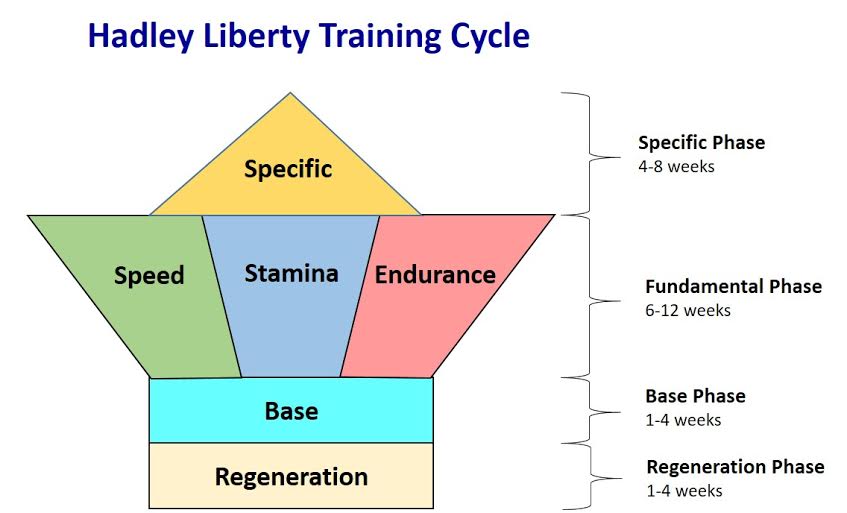
When designing a training cycle for a runner, we want to find a way to build fitness and then hone that fitness into an ability to run a specific race or races at our peak or maximum performance (hence the name of this book).  

I have developed what I call the “Hadley Liberty Training Cycle” to best accomplish this mission.  I use the word liberty in the title because of the cycle designs resemblance (see picture above)  to the torch on the Statue of Liberty.  

The typical Hadley Liberty Training Cycle is between 12 and 24 weeks long, but can be modify if needed to fit other time frames.  

The Hadley Liberty Cycle is made up of 4 training phases that are designed to bring about an athlete's maximum performance for a goal race or sub-set of races.   

In this chapter I’ll discuss each phase in general and how it all fits together and then in the Chapters 7-10 I’ll dedicate a whole chapter to each phase to discuss it in greater detail.  

Regeneration Phase

The training cycle typically starts with the Regeneration Phase that occurs after the goal race of the previous cycle. The purpose of the Regeneration Phase is to allow the runner to recover mentally and physically from the last training cycle before beginning serious training for the next goal race.  After a long training cycle the body and mind need some time to rest & recharge their batteries in order to be ready to begin hard training again.  

The length of time needed for a Regeneration Phase depends on many factors including how long the last cycle was, how hard and long was the last goal race, and how the athlete feels mentally and physically.  Typically the regeneration phase will last anywhere from 1 to 4 weeks in length.  The runner should not move on to the Base Phase until they feel recovered and mentally and physically ready to resume serious training.  

The Regeneration Phase is made up of rest days, short easy runs and light cross training (if desired).  The Regeneration Phase does not include any stress workouts and short easy runs are done only to promote recovery and maintain some level of cardio-vascular fitness and adaptations to running.  

Note:  If a runner is coming off an extended break from training or has been in a low level maintenance running mode for a while, then a Regeneration Phase is not needed and the athlete can start their training cycle with the Base or Fundamental Phase depending on their exact situation.  

Base Phase

The purpose of the Base Phase is to re-introduce stress workouts into training and slowly transition the body back into a base unit structure.  Stress workouts during the Base Phase are kept to more moderate in difficulty with targets/goals kept broad and soft, and recovery is kept ample and conservative.  Following a Regeneration Phase the body will have regressed slightly in its cardiovascular fitness and adaptations to running, so the Base Phase provide the runner with a period of training to transition back into hard training and build back up their cardio fitness and adaptations.  It can be hard both physically and mentally to go from resting immediately into full training mode so the Base Phase provides us with that needed transition.  

The Base Phase can last anywhere from 1 to 4 weeks in length and as a good rule of thumb it generally lasts the same length as the Regeneration Phase did.  So if we take 2 weeks of Regeneration Phase after our  goal race from the previous training cycle, then we can figure on roughly a 2 week Base Phase to follow it.   The reason for this is that the longer the regeneration break the more time needed to build back fitness and adaptations.  In rare cases when the runner is coming back from an extended break the Base Phase can be lengthened to 6-8 weeks in duration to provide a larger window of opportunity to get re-accustomed to stress workouts and rebuild basic fitness before attempting more focused training.

Note:  sometimes a runner stays in a maintenance mode of training for an extended period of time (do any one of a variety of reasons such as work, life, etc).  Often this maintenance level of training resembles a Base Phase.  If a runner is getting back into training seriously again after a period of maintenance training then they can skip the Regeneration and Base phases and start their training cycle with the Fundamental Phase.

Fundamental Phase

The Fundamental Phase is the 3rd phase in our training cycle and it is the longest phase.  The focus of the Fundamental Phase is on balance and on improving the fitness of the runner in each of the 3 main categories of running fitness: speed, stamina and endurance.  As such the stress workouts in a Fundamental Phase are balanced in frequency with regular workouts from each category.

A Fundamental Phase uses macro-cycles to build a sub-set of fitness within each category of fitness (speed, stamina and endurance) and then leverages and builds upon the fitness gain/adaptation in the next macro-cycle.  The exact look of the Fundamental Phase will differ slightly depending on the runners strengths and weaknesses and on the length of their goal race(s) that training cycle.  We will explore those difference in greater detail in Chapter 9.  The Fundamental Phase is a good opportunity for a runner to work on a weakness in an area that may be holding their development and future potential.  

The Fundamental Phase of a training cycle usually last between 6 and 12 weeks in length and is usually roughly 50% of the training cycle as a whole.   

Note:  Runners who do not have a specific goal race they are training for, but rather are seeking continued fitness growth over a long period of time may opt to stay in a Fundamental Phase for an extended period of time breaking it up periodically with a short Regeneration and Base phase and never going through a Specific Phase.  

Specific Phase

The Specific Phase is the last phase in our training cycle and it takes the balanced running fitness established in the fundamental phase and builds it to a peak for a specific goal race distance.  The stress workouts in a Specific Phase focus more heavily on the specific demands of the goal race and transitions general running fitness into specific fitness.  

What the Specific Phase looks like depends on the length of the goal race, the strengths and weaknesses of the runner and any specific features associated with the goal race (i.e course, weather, etc.).  In the Specific Phase our mix of workouts shifts to focus more heavily on the categories that includes our goal race pace, and other specific workouts are added to provide additional training in areas critical to the goal race itself.    

A good example of this is in a specific phase for a marathon race, where we will have the runners do more long tempo runs at or near marathon race pace in order to get more familiar and comfortable with it and develop a good sense for it. And we'll begin to add in more quality into long runs to get the body and mind use to running at quicker rhythms while tired and lower on glycogen. We also do more runs on course that resemble our goal race course to prepare the body for its demands.

The Specific Phase usually last between 4 and 8 weeks in length or roughly a third of the training cycle as a whole.


Note:  In general the Specific Phase should not be extended beyond 8-10 weeks or the runner risks a degradation in the underlying fitness of areas not included as often in the Specific Phase stress workout mix, and this degradation can cause a cascading effect on other areas supporting specific race needs.  

Ok, so that is an overview of the Hadley Liberty Training Cycle as a whole. Each phase will make more sense as we discuss each in greater detail in the next 4 chapters.

Monday, October 31, 2016

Chapter 5: Base Units, Micro & Macro-Cycles

Note: To me coaching is all about stewardship, using the knowledge and experience I have gained over 40 years as a runner, and 10 years as a coach, to help others pursue their running goals.  So rather than publishing a book you have to pay for, I am publishing it here on my blog, free for all (runners and coaches alike) to read and enjoy, maybe learn something from it, or potentially have it prompt you to look at something from a slightly different viewpoint.  If any of those happen, mission accomplished. 

Now that we have covered the basics tenets of training and discussed what stress days and recovery days look like.  It is time to put that information to use and talk about how we use it to design our training cycles.  We’ll spend the next several chapters doing just that.

As our first step in that journey in this chapter we will talk about the basic building blocks of our training cycle design: base units, mico-cycles and macro-cycles so we have some common terminology and tools to work from.

Base Unit

The base unit in our training is 1 stress and recover cycle as discussed in Chapter 2.  Generally in training this is between 2 and 4 days in length made up of a stress workout day followed by 1-3 easy recovery days.  We stress the body on the first day and then allow it to recover on the subsequent days.  How many days of recovery we need depends on many factors including how long and hard the stress was, our age, fitness and all the factors discussed in the last chapter.  The fitter you are, the more running you can do on your recovery day portion of this base unit structure.

We try not to go beyond 4 days typically for a base unit because of the need to stress so many various systems on a regular basis (or some may backslide) when building our fitness. So we attack stress workouts in such a ways as they gain the adaptations we are seeking while allowing us to recover within a 1-3 easy days afterwards. If we regularly do herculean workouts and needed 5-7 days to recover we would see backsliding in fitness in the areas not worked in those herculean workouts. Instead, steady and effective win the race of building fitness.

The 3 most common base units look like this:

2 Day Base Unit:  Day 1 - stress; Day 2 - recover
3 Day Base Unit:  Day 1 - stress; Day 2 - recover; Day 3 - recover
4 Day Base Unit:  Day 1 - stress; Day 2 - recover; Day 3 - recover; Day 4 - recover

Micro-Cycle

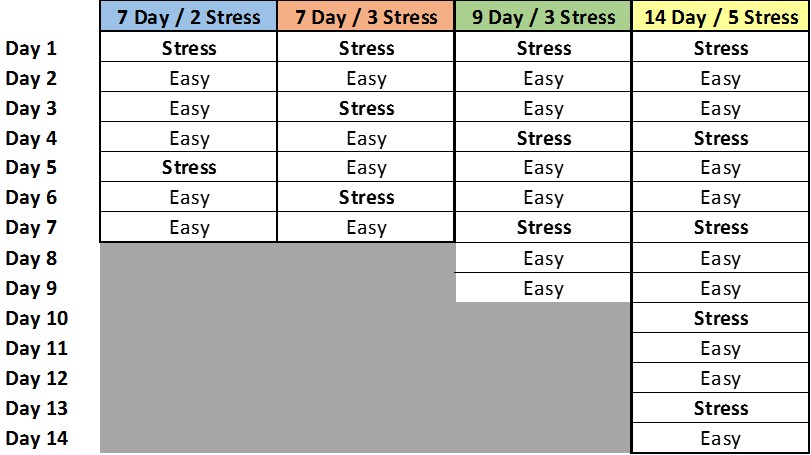
A micro-cycle is the next larger unit in our training cycle and are a repeatable pattern of between 2 and 5 base units long.  There are a few different ways to sequence these micro-cycles depending on your time constraints and recovery needs.  The 4 micro-cycle versions I have had the most success with are as follows:


7 Day Micro-Cycle
Many runners find it most convenient for them to follow a repeatable 7 day base unit.  This can be done with either 3 stress days (for athletes who recover quickly from workouts) or with 2 stress days for those who need a little more time between workouts.  Either can be very effective.  Some runners who need to work on a 7 days micro-cycle find that they can handle more than the 2 stress days per week but that the 3 stress days is not quite sustainable.  For these runners I use a two and half (2.5) stress workout micro-cycle, where we do 2 normal stress days and one lighter stress day where the amount of work is reduced.  For example, we may do a 90 minute run with 45 minutes of it easy and 45 minutes at a brisk pace, so the workout is less stressful than normal 60-90 minute brisk pace workout.  In this type of weekly set-up 2 easy/recovery days are taken after the most stressful workout of the week and a 1 easy/recovery day after the other stress day and the half stress day.     

9 Day Micro-Cycle
Many professional runners, especially marathoners, or those runners with flexible time/job schedules, find that the 9 day micro-cycle structure is ideal with its 3 x 3 day base unit structure. It allows for 2 recovery days after each stress workout which allows the runner to handle a little more mileage on those recovery days than would be possible with just 1 recovery day.
14 Day Micro-Cycle
Many marathoners who also have a regular job/career or who are in school, find that they have a hard time doing an endurance stress workout (i.e. long run) during the work week or school week (Mon-Fri) so their micro-cycle design must allow for their long runs to be done on the weekend.  A 14 day micro-cycle works very well for this. Started on a Monday, this structure gives you 5 stress workouts on Mon., Thu., Sun., Wed. and Saturday in a 2 week period.  The Sunday and following Saturday workouts can be reserved for long runs and the other 3 workouts can be some mix of speed or stamina workouts as needed for the phase the runners is in.  This schedule does leave 1 base unit with only 1 recovery day in it (Saturday long run, Sunday easy run and Monday stress day).  The way I recommend they handle this by doing half of your normal easy day run distance or duration on that Sunday to allow for ample recovery before the Monday stress workout.  

In a micro-cycle, we move through a series of stress workout categories meant to work on a specific set of fitness needs (see Chapter 3 for more on each stress workout).

How we structure which stress workouts we do on our stress workouts day in a micro-cycle depends on what training phase we are in and will be discussed in Chapters 6-10.

Macro-Cycle

A macro-cycle would be our next largest building block in our training programs and is made up between 2 and 5 micro-cycles.  The purpose of a macro-cycle is to focus more heavily on a certain adaptation or sub-set of fitness within our greater training phases (discussed in Chapter 6).  An example maybe using a macro-cycle to place a slightly greater focus on developing your base speed (Fast Repeats) before moving on to a macro-cycle focused more on VO2 Max development; or focusing on building gains in lactate threshold in 1 macro-cycle before levering that into aerobic threshold gains in the next macro-cycle.  We would still seek to have a general balance to our training but with a slightly greater emphasis on a sub-set of fitness in each macro-cycle.  This allows us to sequence training and link improvements in fitness between related areas.  We can leverage gains made in one area during 1 macro-cycle to gains in another area in the next macro-cycle.  We will go into more specifics on how this is done when we discuss each training phase in great detail in later chapters.


Putting It All Together

Now that we have the workouts and building blocks to work with, over the next several chapters we'll get into how we put it all together to build a successful training program.


Friday, October 28, 2016

Chapter 4 - Recovery

Note: To me coaching is all about stewardship, using the knowledge and experience I have gained over 40 years as a runner, and 10 years as a coach, to help others pursue their running goals.  So rather than publishing a book you have to pay for, I am publishing it here on my blog, free for all (runners and coaches alike) to read and enjoy, maybe learn something from it, or potentially have it prompt you to look at something from a slightly different viewpoint.  If any of those happen, mission accomplished. 


In this chapter we want to talk about the “recover” phase of the Stress & Recover Principle we discussed in Chapter 2.  

Our recovery between stress workouts includes far more than just if we run or not.  It includes factors such as what we eat and drink and when, our sleep, our daily activity outside of running, our stretching, rolling, massage and other recovery therapies we engage in.  But what runs we do does play a major factor in our recovery so let’s start there in our discussion.

Easy Runs

I define an easy run as follows:

Easy runs are runs we do in order to promote recovery from our stress workouts while maintaining or advancing our cardiovascular fitness and our body’s adaptations to running.  These runs should be kept short enough in duration and slow enough in pace that they do not significantly stress the body’s systems, while being quick enough to maintain bio-mechanical efficiency and provide cardiovascular benefit.  

Duration
The duration of an easy run can be anywhere from 20 minutes to 90 minutes in duration depending on the fitness level of the runner and the weekly mileage level they are accustomed to.  20 minutes represents the low end as it takes 20 minutes of sustained exercise to provide the cardiovascular, enzyme and hormone benefits we are after.  90 minutes represent the upper most limit as it even for very fit runners runs over 90 minutes become significantly draining of the energy systems of the body and begin to resemble endurance stress workouts rather than easy recovery runs.

One helpful way to determine how much you should run on an easy run day is to use what I call the “5-15 rule” which says that your daily easy run mileage on a recovery day should be between 5% and 15% of your weekly mileage.  Where in that range you would fall would depend on how many recovery days you have between stress workouts.  If you only have 1 recovery day between stress workout then you would be lower in the range, probably somewhere between 5-10%.  If you have 2 or 3 easy days between stress workouts then you can be a little higher in the range at between 10-15% each day.    

For a 50 mile a week runner this means that if they only have 1 recovery day between stress workouts they would probably run between 3-5 miles that day.  But if they had 2 or 3 recovery days between stress workouts they could probably handle 6-8 miles easy each day.  

Speed
Going back to the definition of an easy run, we want to be sure to run it slow enough not to significantly stress any systems of the body so we can assure we are recovering, while being quick enough to remain bio-mechanically efficient and provide some cardiovascular benefits

Given these parameters, I have come up with 3 guidelines for us to follow to judge if we are running within the correct range on our easy days to satisfy our definition.  We should use at least 2 of the 3 guidelines on any given run.  

Feel:  our easy run pace should feel comfortable and relaxed, never pushing the pace and we should be able to easily carry on a conversation with a running partner.

Heart Rate:  our easy runs should average between 65% and 75% of maximum heart rate.  For example of your maximum heart rate is 180 beats per minute than your average heart rate on your easy run should be between 117 (65% of 180) and 135 (75% of 180) beats per minute and you should stay somewhere in that range most of the run.

Pace:  our easy run pace should roughly be between 20% and 30% slower than our lactate threshold pace.  I have pace charts later on in this book to help you determine what this pace is for use based on recent race times.  But basically we define lactate threshold as the pace you can hold for 60 minutes in an all out effort.  So if you can run 60 minutes for a 10 mile race than your lactate threshold would be 6:00 per mile.  This would put your desired easy run pace at between 7:12 (20% slower than 6:00) and 7:48 (30% slower than 6:00)  per mile.

I recommend using the feel as your primary guide on these runs and then use either heart rate or pace as a secondary sanity check to make sure you in the right general ballpark.

Pitfalls
As a coach the 3 most common errors I see runners making on their easy runs are:

  1. Running too fast.  Competitive runners are driven individuals who want to improve, and sometimes that drive can cause them to run too fast on their easy runs.  The pace does not seem physically hard to them so they can easily do it.  But the end results is that it either does not allow them to adequately recover from their stress workout in the allotted time given or they need additional time to recover and so have to an extra recovery day.  Often we see these runners sticking to their workout schedule and go into their next stress workout under recovered and thus not getting the full benefits of their last stress workout, and not being ready for the demands of the next one. As you get fitter your easy runs will get faster, but you don't get fitter by running your easy runs faster.
  2. Running too slow.  A far less number of runners error on the other side of the spectrum here and run too slow on their easy runs.  They very slowly jog (what I like to call ‘slogging’) their runs at a pace that is too slow to provide any significant cardiovascular benefits and at a pace in which they are bio-mechanically inefficient.  They fail to meet our definition for easy runs because they are not getting the cardiovascular benefits desired and they are teaching their body bad bio-mechanical habits which can hurt their efficiency when do try and run quickly in workouts and races.  
  3. Running too far.  Even if a runner stays within the feel, heart rate and pace guidelines given they can sabotage their recovery by trying to run too far on their easy days, often in an attempt to up their mileage.  If a runner pushes too far on an easy run, further than their fitness level is ready for, they will not recover sufficiently from their stress workout before their next stress workout and thus not get the full benefits from it.  Increases in mileage levels on easy runs needs be kept small and gradual to allow the body to adapt and absorb the increases gradually.  

Now that we have looked at the easy runs we do during our recovery phase of the Stress & Recover Principle, lets look at some other factors that play into our recovery.

Other Factors In Recovery

Cool-downs
Our recovery starts as soon as we finish our stress workout and on quality stress workouts often this means on our cool-down jog.  Finishing a quality stress workout (such as speed work or a tempo run) with an easy cool-down run can help start the recovery process by helping to remove waste products accumulated in the muscles from the workout and flush the muscles with the oxygen and nutrient rich blood they need to begin to repair themselves.

Eating & Drinking
When we eat and drink is almost as important as what we eat and drink when it comes to our recovery. There are 3 time frames we want to consider when planning our post workout nutrition.

  1. The first 20 minutes post workout - it is important to start the process of rehydrating and refueling the body in the first 20 minutes after a stress workout as well as after our easy runs.  During this first 20 minutes our bodies will be the most receptive to and in need of hydration and fuel.  Liquids such as water, recovery drinks, sport drinks, and chocolate milk and foods such as sport nutrition bars, or fruits such as bananas consumed in the first 20 minutes after a workout can help the body start to replace the fluids and electrolytes lost in the workout, and the nutrients needed to start the body’s recovery process.
  2. A balanced meal with within the first 2-3 hours post stress workout.  The fueling we take in during the first 20 minutes will help get the recovery started but we’ll burn through that quickly so we want to be sure to get in a good balanced and substantial meal within the first 3 hours post workout but even better within the first 2 hours.  Also during this first 2-3 hours we want to continue to work on rehydration to replace lost fluids from the workout.
  3. The other 21 hours of the day.  Proper hydration and fueling is a 24 hour a day job and important to recovery.  The body will need to be kept properly hydrated and fueled in order for it to recover well.  If you fall short on either it will hurt or delay your recovery.  The best thing to do is to establish some good everyday hydration and eat habits that you can make part of your lifestyle to help ensure you have this area covered.  

Sleeping
The body and mind recovers best when we are sleeping. The body release certain hormones and chemicals when we sleep which help us recover. This fact makes your bed your the number one recovery tool you have.  Similar to eating, establishing some good sleep habits and patterns can go a long way to making sure we get enough sleep to operate at our peak. And naps (even as short as 20 minutes) can be a great way to supplement if we don't get enough at night.  An afternoon nap after a morning stress workout goes a long ways to help the recovery process.

Daily Activity
How much activity we do on a day to day basis will affect our recovery and so should be taken into account when scheduling how much recovery we need after a workout.  If we are stuck on our feet for most of the day, or in a car and unable to get out and stretch our legs regularly it can impact how quickly we recover from our workouts.  Often we do not have full control over this because of job, family and other obligations, but it is something we want to consider in planning our recovery and to mitigate conflicts to the extent we can.  If you have a desk job for example, you can get up once per hour and stretch your legs with a quick walk to the break room for some water.  Bam - stretching the legs and hydrating - 2 birds, one stone.

Stretching
We will talk about stretching in more detail in a later chapter, but keeping your muscles loose by working out any tight spots with regular stretching is important for recovery.  Besides helping loosen tight areas, regular stretching can reduce soreness and also promotes blood flow to the muscles which will enhance recovery.

Rolling & Massage
The use of various rollers, massage balls or self or professional massage can be very helpful to loosen tight muscles, work out muscle soreness and promote recovery.  But it is important to note this must be done in moderation.  Too aggressive massages or rolling can break down the muscles fibers some and that can actually require additional recovery time rather than less recovery time.  This may be desired and helpful in the case of injury but is not wanted or needed in the normal course of training.  If an injury is not present keep rolling and massage to a light maintenance level to aid with recovery.    

Other Recovery Therapies
Other recovery therapies can also be helpful to speed along recovery and get you ready for that next stress workout.  A couple common examples include:
  1. Ice baths - taking an ice bath can aid the recovery process and help rejuvenate the legs.  Especially in warm weather ice baths are used by many runners after stress workouts to help jump start the recovery process.  Scientists still are not universally convinces of its merits, but it has been a tried and true method used by runners for decades.  
  2. Warm Epsom salt bath - similar to ice baths warm Epsom salt baths have been used by runners for decades to help relieve tight and sore muscles, increase circulation and aid the recovery process.  Many runners use ice baths during the warm weather months and warm Epsom salt baths in the colder months with good effect.  

While we naturally think of and focus on our easy runs when we plan our recovery, make sure you consider the other factors discussed in this chapter to help you get the most out of your recovery and keep your training on track.