Wednesday, July 24, 2013

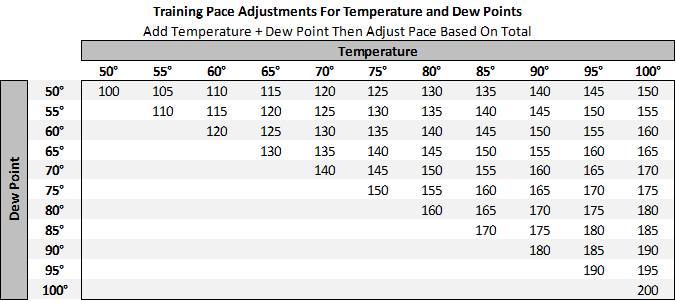
Temperature + Dew Point For Pace Adjustments


Since Dew Point is a more useful measure of the water saturation of the air and thus its effect on our body while we run, I am recommending using it (rather than relative humidity), in conjunction with air temperatures, in determining warm weather pace adjustments to training.

The revised training pace adjustment formula is as follows:

Add together air temperature and dew point and see where the combined number places you on the following adjustment chart:

100 or less:   no pace adjustment
101 to 110:   0% to 0.5% pace adjustment
111 to 120:   0.5% to 1.0% pace adjustment
121 to 130:   1.0% to 2.0% pace adjustment
131 to 140:   2.0% to 3.0% pace adjustment
141 to 150:   3.0% to 4.5% pace adjustment
151 to 160:   4.5% to 6.0% pace adjustment
161 to 170:   6.0% to 8.0% pace adjustment
171 to 180:   8.0% to 10.0% pace adjustment
Above 180:   hard running not recommended

Note:  a range is given as there are numerous individual factors, such as the size, fitness and physical make-up of the runner, and their level of acclimatization to the heat and air saturation levels, that will play into how much of a pace adjustment is needed.   

The above are the pace adjustment percentages to use for continuous runs.  For repeat workouts such as 400’s 800’s, or mile repeats, I recommend using half of the continuous run adjustment as the body has a chance to cool somewhat during the recovery between repeats. 

For those who want help doing the math for these adjustments the following charts calculate the adjusted pace for various paces and % adjustments.


Examples:

At the time of our planned continuous run the air temperature is 74 degrees and dew point if 71 degrees - a typical early morning in summer over much southern United States this summer.  We would add these 2 numbers together to get 145 (74 + 71).

According to our chart, a total of 145 calls for a pace adjustment of 3% to 4.5%.  We had planned to do our run at 7:00 pace under normal conditions, so we adjust the 7:00 pace by 3% to 4.5% and get an adjusted pace range of 7:13 to 7:19 per mile.  

If, under those same weather conditions we had planned to run 8 x half mile repeats at 3:00 per repeat (6:00 per mile pace).  We would cut the 3% to 4.5% pace adjustment in half and use a 1.5% to 2.25% pace adjustment.  A 1.5% to 2.25% on 6:00 pace is a 6:06 to 6:08.  So instead of targeting 3:00 per half mile, we would have an adjusted target of 3:03 to 3:04 per half mile.

Prior Method
Most of the pace adjustments obtained using this method align very closely to what I have shared previously when using relative humidity to adjust air temperature; but I believe the use of both dew point and air temperature to be a more accurate basis for the adjustment calculations, so I am offering this modification.  

Wednesday, July 17, 2013

Sharing My Workout Toolbox

My Metaphorical Workout Toolbox

One of the most valuable items I have as a coach is my workout toolbox.  This is a listing of all the workouts I use as a coach and notes about when, where, why and how to use each to its maximum effectiveness. 

I have a rather large toolbox and am always seeking ways to improve and expand it.  I am constantly reading, thinking, analyzing and talking with other coaches and runners about the various tools used in training.   But I am also picky about what is in my toolbox, so I have some very stringent criteria that must be met before a workout is added.   Before a workout is added to my tool box I must have a thorough understanding of:
  •    The basic physiology of the workout – what systems does it work and how
  •    When to use the workout
  •    How to best execute the workout
  •    Any variations of the workout and how do they differ from each other
  •    How effective is the workout at producing results

The sources for workouts are almost endless.  It is bound only by resources and imagination.  The sources of the workouts currently in my toolbox include:  personal experience as a runner, experiences as a coach, the experiences of friends and colleagues, through reading articles, books and research reports, by talking with other coaches and runners, and hours of research, analyzing and brainstorming.  

I am also not afraid to tweak workouts once they are in the toolbox.  I am always seeking ways to improve them and make them more effective or identifying new variations to be used in certain circumstances.  As new information or research is available, and as experience with each workout grows, I may modify or expand a workout in the toolbox or add a new workout.  I think my toolbox has been through the fire and proven to be extremely effective, but I am never satisfied with that, I want it to be even better and will always work to make improvements to it.  As a coach I want to have the most effective, bad-ass toolbox in the business, so I can be the most effective coach I can possibly be at helping runners reach their goals and maximum potential in the sport.

Organizing the Toolbox
My tool box is organized into 2 tiers.  The first tier is general workout category based on the primary purpose of the workout.
·         Speed
·         Stamina
·         Endurance
·         Recovery

Then under this first tier is a second tier based on the prevalence of the workout in terms of how often and when it can and should be used.  This tier is broken up into:
  •  Staple Workouts
  •  Breakout Workouts
  •  Specialty Workouts


Sharing My Toolbox
On August 1st, I will be launching a new retail page to my coaching services and resource website mprunning.com.  On this page I will be offering to share a substantial piece of my toolbox with you, and in a detailed way beyond what is found on my websites or blog, through a product entitled:   

Coach Hadley’s Workout Toolbox

This offering will include:
  • Detailed notes, instructions and tips on the top 18 workouts in my toolbox. 
  • Training pace charts so that you can easily determine the correct pace ranges to use for each workout based on your (or your athlete’s) current fitness level 
  • All organized on to 8” x 5” note cards, laminated, so they can easily be taken to workout sites to be used and referred to.  


Wednesday, July 3, 2013

The 5th Tenet: Passion!


“A life lived with passion, even if it fails to reach its goals, is far superior to a life lived without passion, even if it is successful”

For the last couple of years you have heard me talk about what I believe to be the 4 tenets of training for distance running in order to achieve your full potential in the sport:  consistency, capacity, frequency and mixture.   Today I want to introduce you to a 5th tenet:  Passion!

Let me explain what I mean by passion in terms of distance running, and how it is a vital component to our success.

Passion:  A deep desire and love of the sport to the point that you decide to do your very best and develop the talent you have for it.  This passion requires that you maintain a positive attitude about training and racing because running is seen as a great gift and as such it is a privilege to do no matter the outcome of the run, workout or race.

This passion, by its very definition, requires us to also approach training in a smart and disciplined manner, as well as an enthusiastic one, because it will take smart training coupled with hard training to reach our full potential.   This means while enthusiastic about workouts and working hard, we must balance that enthusiasm in order to make sure we adhere to the other tenets of training, because ultimately we must have all 5 tenets working together in unison in order to realize its full synergy.  

Thing we need to know about this passion we seek:
  • Passion is part feeling and part conscious decision – we have to want it (the easy part) AND have to make the conscious decision to embrace it and make it happen (the hard part).
  • If it is not fed and safe guarded, passion can be diminished or even extinguished and if not kept in check it can burn too high and burn out.  So the passion we seek avoids the extreme highs and lows and instead steadily and resolutely marches forward towards its goal.
  • The passion we seek is a strong burning but resolute flame, the kind that can weather the storms that will surely come from time to time, the one that will slowly forge our bodies and minds in to rock hard manifestations of distance running prowess over months and years of work.
  • When tough conditions present themselves, such as inhospitable weather or challenging courses, this passion embraces the challenge before it and see it as an opportunity to grow, harden itself and improve.  Its thoughts are never “how do I survive this” but rather “how do I conquer it”. 
  • Passion is an attitude that permeates all aspects of our training on a daily basis, not just when we get ourselves psyched up.  It is positive, it is resolute, and it is unwavering. Ups and downs in training do not affect its strength or mission. 
  • If we train with passion we have no need to brag or be obnoxious on race day to try and psych ourselves up, instead we arrive on the start line with a calm confidence, knowing we are ready for the task at hand.  

When this passion and attitude is coupled with the other 4 tenets, we become a virtually unstoppable distance running machine. The only question is when we will arrive at our goals, not if we will arrive.  That is not to say we won’t have set backs or make mistakes along the way, but when we do we will learn from them and quickly rise again and march forward again towards our goals.  Just like a fully loaded freight train, we will be almost impossible to derail until we reach our goals and beyond.

My 5 tenets to successful distance running training:
  • Consistency
  • Capacity
  • Frequency
  • Mixture
  • Passion


Monday, July 1, 2013

Staple and Breakout Workouts

A Very Motivating Breakout Speed Workout 

Every training program should be comprised of both staple workouts and breakout workouts. 

Staple Workouts:  These are the tried and true workouts that are very effective at working certain targeted systems in a very direct manner.  These workouts include things like VO2 Max repeats, LT tempo runs, and the easy pace long run.  They are simple, straight forward and usually very effective.

Breakout Workouts:  These are the workouts we add into the program in order to spice things up, work systems from a slightly different angle in order to spark new growth in order to keep the fitness progression from stagnating.  These workouts include things like hill repeats, wave tempos and progression runs.

Mixture
Staple workouts will comprise the majority of the workouts we do in training but the exact mixture between staple and breakout workouts will depending on many variables including previous training cycles, number of years of purposeful training, and length of the current training cycle. 

Similarly, what breakout workouts we utilize will depend on variables such as the individual’s strengths and weaknesses, their prior training, and what distance they are training for. 

Good intuition, lots of experience, and a sound understanding of the physiology of all the workouts, are the keys to finding the right mixture between staple and breakout workouts and also finding the right workouts within each to utilize and when. 

Tips
  • Have a couple of different breakout workouts for each workout category – speed, stamina and endurance. 
  • If your fitness progression in a certain category starts to stagnate, add in a breakout workout for that category into your training. 
  • Keep a training log and note the breakout workouts you have used in the past that have been the most effective for you.  


Monday, June 24, 2013

Blood Tests For Runners


As distance runners we are diligent with our training routines and try and make sure we are doing all the little things we need to in order to make sure our body is fit and ready to train and race hard.  But it isn't always as simple as it sounds to make sure that you are adequately or optimally doing everything .  In blocks of hard training the things we need to keep up with and monitor go up, and the things we do in easier training may not be adequate any longer.   

Specifically in this blog I am referring to the level of hydration, electrolytes, vitamins, minerals, enzymes and hormones that our body needs in order to perform at its maximum.    In order to monitor and ensure these areas are at optimal (or at least sufficient) levels I am recommending that competitive runners, especially those running higher mileage levels, have some simple and relatively inexpensive blood tests performed on a periodic basis.   The benefits of doing so is 2 fold – first it helps us determine if there is any area of immediate concern that may be derailing or jeopardizing our current ability train and race optimally; and secondly by tracking our test results over time, we can see pick out any potential troubling trends and better learn our body and at what score in various areas do we usually perform our best.  These periodic tests can help us fine tune our ancillary (non-running) routines in order to help us perform at our best. 

OK so how often and what should I test?  Good questions and like most things on our sport the answer is “it depends”.   But I do have some basic recommendations that are a good start and something I think will be sufficient for the vast majority of serious runners.  Then as we follow these recommendations we can tweak what do to optimize it for our specific situation. 

What Tests To Have
Here is what I recommend that you get tested as part of your periodic testing program:

CBC – Complete Blood Count:  this will give you the white blood cell count, red blood cell count, hemoglobin levels, hematocrit levels, white blood cell types, red blood cell density and blood platelet counts.   Several important things in here to track and some that provide indications of infections, and other problems.

TSH Levels – This gives you a basic indication if your thyroid gland is working appropriately or at least indicate if a more thorough tests should be done in this area. Some runners have problems in this area.

Ferritin Levels – this is a good indicator of the iron stores available in your bone marrow to make new red blood cells.  Many runners, especially higher mileage runners, tend to be too low in this area if they don’t supplement iron intake.   Olympic Marathon Champ Joan Benoit Samuelson, a notoriously good eater, says that iron was the only thing she had to regularly supplement. 

Chemistry Panel – this is a test for many mineral levels in your blood, including key electrolytes such as sodium and potassium.  Also can give you a good indication if you are dehydrated and if you are high or low in any of these key minerals.   

Additional tests can be included such as glucose levels, iron and vitamin D, or others if desired or if you have reason to suspect something may be up or need to be tracked based on personal or family history. 

You can request these tests from your primary care physician or go to an independent lab testing facility, such as “Any Lab Test Now”, and have these tests run.   It is simple and the results are usually back within 48 hrs.   The cost will vary based on if you go through your doctor, what your insurance is,  or if you use an independent facility.  I know that I can get all of the above tests done through “Any Lab Test Now” for a total of $129 (their “Basic Check-up Panel” with Ferritin substituted in place of the Lipids test).

Reading The Test Results
All of these test results will come with a list of what is considered the “normal range” and what your score is.  But keep in mind that what is optimal for an athlete in serious training and what is “normal” may not coincide perfectly.  I recommend that you either find a reputable person in sports medicine who is use to working with athletes and reading blood tests results, to go over your results with you; or you take some time to do some research and reading and educate yourself on how to interpret the results yourself. 

Once you get your results start a spreadsheet and enter your results for each test and the date of the test.  Then when you get the test done again, note your new levels on the next column/row.  This way you will have an easy place to see any trends and possibly catch some potential problems before they fully manifest themselves.   In certain tests you will notice certain levels at which you feel best and what you need to do to get there (such as ferritin and what level of iron supplementation you need to achieve that ferritin level). 

How Often To Test
I recommend having the complete battery of tests done 2 to 3 times per year, with a follow-up test in-between on any area that is outside of the desired range.  For example, if I get the full run of tests done in January and everything looks good except for my ferritin levels, I may make some changes to my iron supplementation routine and then just have just my ferritin levels tested again in March to make sure my changes are working.  Then have the whole battery of tests done again in May or June.   Additionally if you run into a period of a few weeks in which we aren't feeling well and something seems off, by getting the full battery of tests it may help you isolate the problem. 

As serious runners, we want to leave no stone un-turned as we seek to achieve our goals, and these test can help us make sure we are doing what we need in terms of hydration, nutrition, vitamins and minerals, as well as point out any issues that may be lurking. 

Return on Investment
While following this recommendation can costs a few hundred dollars per year, it can also help make sure that you are getting the most out of the hundreds of hours you are putting into training and often the thousands of dollars you are investing in race entries and travel to races.  In all a very good return on your money in addition to the invaluable peace of mind it can bring.

Happy Running,


Coach Mark Hadley

Tuesday, June 4, 2013

Onward and Upward - Refinements In Philosophy


On the home page of the EliteMarathoning.com website I make the following statement:

“In early 2012, I decided to publish my training and racing philosophy for the marathon as a website rather than as a book.  This way it can be kept in a more dynamic setting and updated in real time when advancements are made, thus never letting the philosophy go static, but rather let it always be evolving and advancing. It is my sincere hope that this site can be a good reference tool to others (runners and coaches) and help them reach their full potential in marathon running.”
 - Coach Mark Hadley

I mean every word of that quote and in particular a couple of phrases in there: “dynamic setting”, “never letting the philosophy go static”, “evolving and advancing”, go deep to the heart of my coaching philosophy.  I never want to stop learning, to stop thinking, to stop exploring this sport.  Every experience should bring a deeper understanding, and every conversation spark a new way of looking at something.  I want my mind to churn for days on end with new ideas, tweaks to old ideas and to pour over all possible scenarios.  And through this, continue to advance and refine my training and racing philosophy for the longer distances so I can be even more effective at helping runners reach their potential in these races. I see it as an intellectual challenge, wrapped in a mission of service and stewardship.  Three things close to the core of my being. 

Advancements
For the past several months I have been working on some refinements and advancements to a few aspect of my training philosophy.  This is not a whole sale change of any aspect by any means, but rather further refining aspects to make it more effective at producing the desired results as efficiently as possible. 

Yesterday I rolled these advancements/refinements out on the EliteMarathoning.com website, and today I want to explain them on this blog and have included them on my Maximum Performance Running site as well.

Stress Workout Training Paces
As distance runners specializing on the longer races distances (Half Marathon to Marathon), our lactate threshold and aerobic threshold  (collectively - our stamina) are the areas of primary concern for us and much of our success will be based on how much we can improve these thresholds over time.  So we work regularly on these threshold paces, with 8 of the 16 stress workouts listed in the “Workout” page of the EliteMarathoning.com website dedicated to improving these thresholds.  But in order to support the improvement of these thresholds, we also need to regularly work paces moderately slower and faster than these threshold paces.  To this end I have refined my philosophy to include 3 stress workout training paces faster than these thresholds, and 3 slower than these thresholds, to uniformly support their continued improvement.
   
We want to select training paces that are sufficiently different enough from one another that they cause a change in blood chemistry (i.e. lactate levels, etc.) and/or energy usage characteristics so that we are working targeted physiological systems from significantly different angles, thereby maximizing the effectiveness of different work we do.  In taking a long look at this, I have decided that, for longer distance runners, that significant change in pace we are looking for is the difference between our lactate threshold (LT) and aerobic threshold (AT) paces or roughly a 4-5% change in pace.  So I utilize this change (between LT and AT) as my base unit for pace changes.

This gives me the following breakout for training paces by stress workout category:

Stamina Workouts

Lactate Threshold (LT):  the pace we can hold for 60 minutes in an all-out effort (i.e. race)

Aerobic Threshold (AT):  the pace we can hold for 120 minutes in an all-out effort (or roughly 4-5% slower than LT depending on predisposition). 

To these paces I add a 1% range (on the slower side) in order to allow for some small variations and progressions. 

This workout category did not change.  I still utilize the same paces and workouts in this category as I had previously used. 

Speed Workouts

If we define the change between LT and AT as 1∆  (AT pace – LT pace = 1∆) than our speed workout paces are as follows:

LT - 1∆:  This is speed used for Groove Repeats
LT - 2∆:  This is the speed used for VO2 Max Repeats
LT - 3∆:  This is the speed used for Fast Repeats

Note:  see the “Workout” page on the EliteMarathoning.com website or the "Training Paces" page on the MPR website for details on each workout type

Example:  If LT pace is 5:45 per mile and AT pace is 6:00 than :15 = 1∆, so our 3 speed workout paces would be:

LT - 1∆:   5:30  (5:45 - :15)
LT - 2∆:   5:15  (5:45 – (2 x :15))
LT - 3∆:   5:00  (5:45 – (3 x :15))

Similar to the stamina category, I add a 1% range (on the slower side) in order to allow for some small variations and progressions. 

LT - 1∆:   5:30-5:33
LT - 2∆:   5:15-5:18
LT - 3∆:   5:00-5:03

So how does this compare to what I used previously?   The Groove repeat pace is almost exactly the same but with a slightly smaller range, the VO2 Max Repeats are on the faster end of the range I used previously (and closer to true vVO2 Max), and the Fast Repeats are slightly faster than previously utilized.  I have tweaked the durations of some of these workouts in accordance these minor pace changes.  In most cases my current athletes will not notice any change to their Groove or VO2 Max workouts and a slight increase in speed with accompanying small reduction in volume in some of their Fast Repeat workouts. 

Endurance Workouts

If we define the change between LT and AT as 1∆  (AT pace – LT pace = 1∆) than our endurance workout paces are as follows:

AT + 1∆:   This is the pace used for Quick Pace Long Runs
AT + 2∆:  This is the pace used for Steady State Long Runs
AT + 3∆:  This is the pace used for Moderate Pace Long Runs

Note:  see the “Workout” page on the EliteMarathoning.com website or the "Training Paces" page on the MPR website for details on each workout type

Example:  If LT pace is 5:45 per mile and AT pace is 6:00 than :15 = 1∆, so our 3 endurance workout paces would be:

AT + 1∆:   6:15  (6:00 + :15)
AT + 2∆:   6:30  (6:00 + (2 x :15))
AT + 3∆:   6:45  (6:00 + (3 x :15))

Similar to the stamina category, I add a 1% range (on the slower side) in order to allow for some small variations and progressions. 

AT + 1∆:   6:15-6:19
AT + 2∆:   6:30-6:34
AT + 3∆:   6:45-6:49

So how does this compare to what I used previously?   This area includes some of the bigger refinements I am making, as I have added a completely new category of endurance workout, the Quick Pace Long Run, and I am very excited about it.  The more I see, experience, study, coach and talk with other coaches, the more I realize the importance of the quality aspect in our endurance work.  To that end, the pace I utilize for the standard “easy pace long run” as sped up just slightly and is now called Moderate Paced Long Runs.  Steady State Long Runs have been left virtually unchanged expect for a narrowing of the pace range, and we have added a Quick Pace Long Run to give additional work to energy systems usage closest to marathon pace.  The duration of each workout has been slightly adjusted accordingly.  Lower mileage runners will still mainly utilize the 2 slower paced versions of this category, but the inclusion of the new workout type should greatly enhance the preparations of the higher mileage runners. 

Calculations - No Worries
No worries on trying to figure out and calculate your LT and AT and other paces.  I have done the math for you, based on your recent race times and predisposition.  I have attached training pace charts and equivalent race time charts on both the EliteMarathoning.com and MPR websites.

Predispositions
Additionally I have refined my explanation and use of predispositions in determining training paces and race times.

Given equal preparation, how much an athlete slows down as the race distance gets longer depends on many individual variables ranging from muscle fiber make-up, to bone structure, to mental wiring and personality. Some people’s minds and bodies are better suited for longer races (HM and Marathon) and some for shorter races (5k and 10k).  I call this aptitude towards different distances their natural predisposition.

It only makes sense then that our natural predisposition will play a large part in what our potential is in the marathon and other races. If we have 2 people with the same 10k PR but one has a shorter distance predisposition (person A) and one has a longer distance predisposition (Person B), then Person B will have better potential in the marathon than Person A, and Person A will have greater potential at the 5k than Person B.  Different predispositions helps explain why Desi Davila and Shalane Flanagan were pretty evenly matched in the 2012 Olympic Trials Marathon, but Shalene has a 10k PR a minute faster than Desi.  This also helps explain why Dick Beardsley could run even with Alberto Salazar in the marathon when he might have been lapped by Alberto in a track 10k.  Desi and Dick may simply have greater long distance predispositions than Shalane and Alberto.  Similarly, people who could run with even with Paula Radcliffe over 5k and 10k (granted there were not many of them) generally had a short distance or neutral predisposition while Paula has a long distance predisposition, so she was able to beat them by multiple minutes in a marathon race. This doesn’t mean that a person with a longer distance predisposition can’t run very good at shorter races (Paula was exceptional at 5k and 10k), it just means that their potential is better at the races closer to their predisposition (Paula holds the WR in the marathon, as would make sense given her predisposition).

Doing some research and investigation on this subject over the last several years, I have made some general findings. The typical neutral predisposition distance runner will slow roughly 4.5% each time the distance is doubled (starting at 5k) if they are equally as well prepared for each race distance. Being "neutral" means they will fair roughly the same in equally competitive races at different distances from 5k to the marathon. 

With 4.5% representing neutral, I find the standard range to be roughly 4.0% (long distance predisposition) to 5.0% (short distance predisposition).  This range can make a big difference in the athlete’s potential at various distances. If we you use a 31:00 10k as our base time we see that a runner with a short distance predisposition may only have 2:24:54 marathon potential (slowing 5.0% each time the distance doubles), but a neutral predisposition may have 2:23:20 potential, and runner with a long distance predisposition may have 2:21:46 potential.  That is over 3 minutes difference in marathon potential for runners with the same 10k time.

While there may be a few individuals who fall outside of this 4.0% to 5.0% range (Paula actually is closer to 3.5%), I think the range captures 98% of all serious distance runners.  I break this range down into 3 sub-categories:

Long Distance Predisposition: slows roughly 4.0% - this runner fairs better against his/her peers in the longer races (half marathon and marathon)
Neutral Predisposition: slows roughly 4.5%- this runner fairs about the same against his/her peers in all distance races (5k - marathon)
Short Distance Predisposition: slows roughly 5.0% - this runners fairs better against his/her peers in the shorter races (5k and 10k)

My terminology is distance running specific so “short distance” is 5k-10k and “long distance” is the half marathon-marathon.

It is important to note that all of this assumes the runner is equally as well trained for each distance. This will not be the case for a lower mileage runner, as 60 miles a week will not allow you to be as well prepared for a marathon as it will for a 5k or 10k. For this reason it is hard for some recreational or even sub-elites to fully judge their predisposition based strictly on race times.

Our predispositions are not something that we can influence or change to a great degree, rather it just shows us what distances we are naturally best off focusing on for greatest potential success. This can be very valuable information for a runner and/or coach to have.

Understanding a runner's predisposition also helps a coach and athlete to understand the appropriate paces to use in training. For example, if I coach 2 runners with 31:00 10k PR's, but one has a long distance predisposition and the other a short distance predisposition, and I send them out to do a 10 mile aerobic threshold (AT) tempo run, the appropriate pace will be different for each of them because of their predispositions even though their 10k times are the same. The runner with the short distance predisposition will need to do this workout at about 5:30 pace while the runner with the long distance predisposition can probably handle about 5 seconds per mile faster on a similar effort.  Similarly if we are doing some VO2 Max repeats the runner with the shorter distance predisposition will probably be able to hit slightly better times than the longer distance predisposition runner. Knowing the runner's predisposition helps in setting expectations and to avoid over-training.

You will notice on both my websites that there are 3 versions of the training pace and equivalent race time charts, one for each main predisposition.  If you are not sure of your predisposition then I suggest using the neutral predisposition charts until see evidence to change from that

Workouts
One final refinement to my training philosophy is that I have added 2 workouts to the mix of workouts I regularly utilize in my training programs.  These two workouts are the addition of the Quick Pace Long Runs that I mentioned earlier, and the second workout is a hill repeat workout that I have used for some time, but never formalized as a specific workout on my websites.

Quick Pace - Long Run
Workout:  continuous long run done at a quick pace
Pace:  AT + 1x pace (AT plus the difference between AT and LT paces)
Duration:  Between 50% and 70% of your marathon race time (i.e. 1:30, etc.) up to a max of 120 minutes. 
Benefits:  Improves glycogen storage capacity, improves energy usage efficiency at a quicker pace, advances cardiovascular fitness and cellular adaptations
Use: Used sporadically in the fundamental phase and regularly in the specific phase of training for a marathon.
Example:  if AT pace is 6:00 and AT + 1 is 6:15, than 90 minutes at 6:15 pace

Hill Repeats
Workout:  Repeats of between 1:00 and 2:30 in duration, done up a hill, totaling between 15 and 21 minutes in total.
Hill:  hill of a moderate grade (3-5% slope) - roughly 6-10 seconds per 400 meters slower than flat.
Pace: roughly LT - 2x (VO2 Max Repeat pace) (LT minus 2 times the difference between AT and LT)
Recovery:  a slow jog back down the hill to the starting spot.
Benefits: Improves stride economy and power, stress aerpbic power (VO2 Max)
Use:  Used frequently early in a training cycle to build power and as a good way to breakthrough a plateau on fitness later in the cycle.
Example:  If LT pace is 5:30 and LT - 2x is 5:00, than 12 x 1:30 uphill at 5:00 pace with jog down recovery  

Additional Explanations
For further explanations I encourage you to read the “Workouts” and “Training Paces” pages of my EliteMarathoning.com website and "Training Paces" page of my MPR website.

Additionally training pace and equivalent race time charts are available on both of the follow locations:
For 10k times from up to 60 minutes:  MPR Pace Charts
For 10k times below 40 minutes:   EliteMarathoning Pace Charts

Onward and upwards my friends, and loving every minute of it!

Happy Running!

Coach Mark Hadley

Tuesday, May 7, 2013

Training In The Summer Heat/Humidity


When we run in warm conditions our body temperature rises and in order to keep from overheating our body starts to take steps to reduce our temperature. The main way our body tries to reduce our temperature is by sweating, which cools the surface of the skin when the sweat evaporates, and then diverting more of our blood flow to the skin surface to cool it.  This diversion of more blood to the skin surface means that less blood is available to be used by working muscles and organs.  This decrease in blood flow to the muscles means that the same work load will require more effort /energy to accomplish or that less work can be performed using the same amount of effort.    

That last part is key to how we train as distance runners in the heat and humidity of summer time.  Trying to run at the same pace for the same distance in the warm weather can require significantly more effort/energy than it will in the cool weather, so we must either reduce the speed or the distance we run (or a combination of both). 

Training Mileage/Distance
Since we are “distance” runners and the length of races don’t change, I am do not believe in reducing the distance of the training we do in preparation for a certain race distance.  This means that if we are training for a marathon in the summer we still run the distances in training required to properly prepare for a marathon, because on race day we still have to run the race distance.  They don’t shorten the race because it was hot when people trained for it. 

Having said that, many distance runners choose to lessen the total mileage needed in training during the summer by racing shorter distances, choosing to focus on speed rather than endurance during this time of year.  This shorter distance focus in the warm weather months is a very valid approach, but may not fit everyone.

Training / Racing Pace
So if the distance we run in training for a specific race isn't changing, than it becomes mandatory to adjust the pace at which we run that distance in warm weather.  The logical question then is: how much should we be slowing our paces?  The answer that question depends on several factors including the air temperature, the humidity level and how acclimatized we are to the heat.  The higher the temperature the harder the body will have to work to cool itself so the more blood that will diverted away from muscles and to the skin surface.  The higher the humidity levels the slower the sweat evaporates which slows the cooling process.  And how acclimatized to the weather we are affects how efficient our body is at this cooling process. 

Here are a few rules of thumb that will help you get in the right ball park when it comes to weather adjustments.

Adjust your pace approximately 0.1% to 0.15% for each degrees F above 60 F.  Early in the season, when you aren't acclimatized, the adjustment will probably be on the 0.15% side but by the end of the season it may be down to 0.1% (or less) when you are use to (more efficient at dealing with) the heat.  Then I would adjust the temperature for the humidity as well.  So if the humidity level is high I might add 5-10 degrees to the temperature I use to adjust the pace further pace. 

This is just a tough rule of thumb to help you get started figuring out an adjustment for you, but you may have to customize this some for you and your specific body make-up and situation. 

Example:   If I normally run 5 miles at 7:00 pace on a cooler weather day, but the temperature when I go out for this run is 80 degrees, than I would slow the pace down by:

80-60 = 20 degrees over 60F.   20 x 0.15% = 3.0%    So 3% slower than 7:00 is 7:13 per mile.  I would do this run at 7:13 per mile target.

If it was also fairly humid that day (60-80%) I might adjust that temperature up to 85 degrees or so giving me an adjusted pace of 7:16 per mile.   If high humidity I might be running at 7:20 or slower.

Note: reduce your adjustment by roughly half when doing intervals/repeats, as the body gets a chance to cool itself back down during the recovery intervals.  There is still an adjustment necessary but it is not as big as on continuous runs. 

Hydration
Since the body’s main way of dealing with the heat revolves around increased sweating, our ability to deal well with the heat will require that we stay well hydrated.  This includes making sure we have good hydration habits all through-out the day, in addition to re-hydrating well immediately after our runs.  While water will be our primary concern, we also need to be sure that we are replacing the electrolytes we lose in our sweat as well.  Our body can take much of these electrolytes from a healthy diet, but during the warmer weather times we may need to also increase our intake of electrolytes through sports drinks or supplements.  During longer runs in warmer weather (over 40 minutes) it may also be a good idea to arrange to take in some fluids during the run.  This will be vitally important during long runs, where some electrolyte supplementation may also be beneficial.

Positive Effects of Heat Training 
So now that we have talked about the downside of training in the heat, let’s talk about the benefits.  There seems to be good evidence that training in the heat may have very similar effects to training at altitude.  Think about it for a minute.  At altitude the level of oxygen delivered by our blood to our muscles and organs is less because oxygen levels are lower at altitude.  The body responds to this by increasing our blood supply so we have more blood with which to deliver the oxygen.  Similarly in the heat, if a portion of blood supply is being diverted to the skin, that leaves less going to the muscles and organs and the body can respond to that over time by increasing our blood supply.  So altitude and heat may be two different ways to achieve the same beneficial adaptation (increased blood supply).  Additionally there is evidence that warm weather training increases our body’s efficiency at cooling itself, which has carry over benefits even when we are running/racing in cooler temperatures.  The less the body has to work to cool itself, the more blood available to transport oxygen to the muscles. 

So instead of dreading training in the warmer weather this summer, embrace it as an opportunity improve yourself as a runner with bout of “poor man’s altitude” training.   Sorry Boulder, Albuquerque, and Mammoth Lakes, I am getting my altitude training done here in the Deep South this summer.   J